Leyes de los Muertos
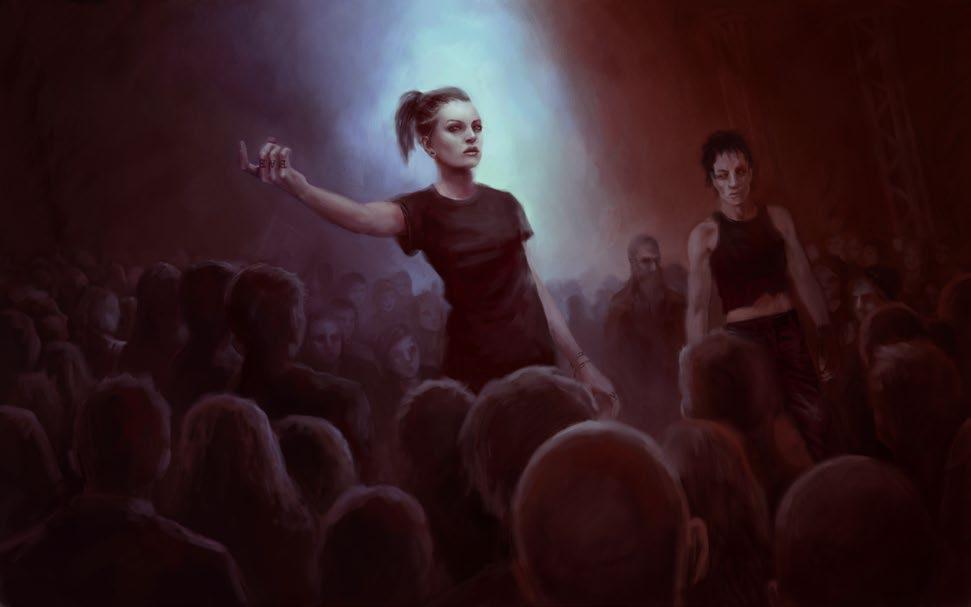
Cuando me convierta en muerte, muerte será la semilla de la que crezca.
Creación de Personaje
Tus personajes de Vampiro: El Requiem interactúan con su Requiem utilizando los mecanismos del Sistema Narrativo. Para determinar cómo encajan mecánicamente en el mundo, creas esos personajes usando los siguientes sistemas. Cada jugadora debe tener una copia de la hoja de personaje que puedes encontrar al final de este libro. La hoja de personaje es el mapa de tu personaje Vampiro.
Por lo general, todas las jugadoras deberían crear sus personajes juntas. Estáis construyendo una historia juntas; es lógico pensar que los personajes deberían, al menos nominalmente, encajar. Incluso si la Narradora planea reunir a todos en la primera sesión del juego, es bueno considerar la idoneidad dramática de los personajes como grupo. Si bien existen bastantes artimañas para unir a cualquier grupo, algunas combinaciones pueden ser demasiado problemáticas como para merecer la pena.
Paso Uno: Concepto de personaje
Si la hoja de personaje es el mapa de tu personaje, el concepto de personaje es la leyenda. El concepto de personaje consiste en un par de palabras que describen a tu personaje en un sentido dramático y literario. ¿Tu personaje es un Pícaro Travieso? ¿Es una Investigadora Itinerante? ¿Es una Tecnochamán Celebrante?
A medida que has leído las secciones anteriores, tal vez el Clan, Secta u otras partes de la ambientación han generado una idea básica para tu personaje. Esa idea es un concepto.
A continuación, necesitarás tres Aspiraciones. Las Aspiraciones son las metas de tu personaje. Ten en cuenta que pueden no ser metas personales del propio personaje, sino propósitos que defines tú para él. Por ejemplo, puede que desees verle perder a un amigo en el transcurso de la historia. Ninguna persona razonable querría perder a un amigo, pero es una Aspiración válida, porque es algo que quieres que suceda en la historia de tu personaje.
Al elegir Aspiraciones, define dos Aspiraciones a corto plazo y una a largo plazo. En este caso, a corto plazo significa algo que podría sucederle a tu personaje en una sola sesión de juego, mientras que las Aspiraciones a largo plazo son eventos que requieren un esfuerzo mayor y más extenso para lograrlas. Expresa las Aspiraciones en pocas palabras, en no más de una frase. Mantenlas genéricas y vagas, pues una mayor especificidad significa que es menos probable que se cumplan.
Como Narradora, debes escribir todas estas Aspiraciones. Estas son una forma de que las jugadoras te digan el tipo de cosas que quieren que sucedan en tu partida. Asegúrate de tratar estas Aspiraciones y dales a las jugadoras muchas oportunidades para ponerlas en juego.
Por último, elige una Virtud y un Vicio. Estos rasgos (explicados en la pág. 244) reflejan la personalidad de tu personaje y proporcionan un medio para recuperar la Voluntad.
Paso Dos: Selecciona Atributos
Cada personaje de Crónicas de Tinieblas posee nueve Atributos básicos. Estos cubren las capacidades inherentes de un personaje. Se dividen en tres categorías: Mentales, Sociales y Físicos. Cada categoría posee tres Atributos Puedes encontrar más información sobre estos Atributos en la pág. 239, incluido lo que representan los distintos niveles de círculos. En esta etapa de la creación del personaje, cada Atributo recibe un círculo gratuito (como se indica en la hoja del personaje). Luego, prioriza las categorías. Elige qué grupo es más importante para tu personaje, luego el segundo más importante y el último. La categoría superior recibe cinco círculos para distribuir, la segunda recibe cuatro y la última recibe tres. Puedes dividirlos como mejor te parezca, pero ningún Atributo puede superar los cinco círculos en total.
Paso Tres: Selecciona Habilidades
A continuación, selecciona las Habilidades. Hay 24 Habilidades, divididas en tres categorías: Mentales, Físicas y Sociales, al igual que los Atributos. A diferencia de los Atributos, las Habilidades no reciben círculos gratuitos. Prioriza las categorías de igual manera que lo hiciste con los Atributos, repartiendo once para la categoría superior, siete para la secundaria y cuatro para la final. Puedes encontrar más sobre las Habilidades, incluyendo información detallada de cada una y las acciones a las que contribuyen, en la pág. 240.
Paso Cuatro: Selecciona las Especialidades de Habilidad
Ahora que dispones de Habilidades para tu personaje, puedes perfeccionar tres de ellas con Especialidades. Las Especialidades son descriptores de una sola palabra o frase corta que ayudan a delimitar el área particular de pericia de tu personaje. Por ejemplo, tu personaje puede tener Ocultismo (Brujería), Ocultismo (Herbolaria) u Ocultismo (Fantasmas). Elige tres Especialidades. Puedes encontrar ejemplos en las descripciones de Habilidades a partir de la pág. 240.
Al elegir las Especialidades de Habilidad, puedes enfocarlas de tres formas principales. Primero, puedes complementar las Habilidades inferiores que aún quieres que use tu personaje. Por ejemplo, es posible que tu personaje solo tenga un círculo de Investigación, pero si tomas la Especialidad «Escenas del Crimen», tu personaje se vuelve mucho más efectivo en ese campo específico. En segundo lugar, puedes maximizar la eficiencia con una Habilidad dominada. Por ejemplo, si adquiriste cuatro círculos en Armas de Fuego, la selección de la Especialidad «Fusiles» hace que tu personaje destaque con un fusil, más allá de otros personajes con solo cuatro círculos. Por último, puedes usar Especialidades para darle a tu personaje un toque y sabor personal. Por ejemplo, tu personaje puede tener una especialidad de Artesanía en «Maquetas». Puede que esto no le beneficie directamente en el juego, pero dice algo sobre tu personaje y sus prioridades.
Paso Cinco: Añade la plantilla de Vampiro
Tenemos sangre y carne. Ahora añadimos los colmillos
Clan
El clan de un personaje es el linaje en el que su Sire le Abrazó. Esto no se puede cambiar una vez empezada la partida, pero tu personaje puede canalizar su linaje hacia una Línea de Sangre. Mira los circo clanes, los Daeva, Gangrel, Mekhet, Nosferatu y Ventrue.
El Clan es más un arquetipo que una personalidad. Mientras que las disciplinas y maldiciones de los distintos clanes pueden influenciar el comportamiento, cualquier persona puede ser Abrazada en cualquier clan. Hay algo que decir sobre jugar estereotipos, pero romper con las normas establecidas puede ser interesante.
Tu elección de Clan determina las Disciplinas con las que tu personaje tiene afinidad. Cada clan también tiene dos Atributos Favorecidos. Coge un punto gratis adicional en uno de estos. Esto no puede hacer que ningún Atributo supere los 5 puntos.
| Clan | Atributo Favorecido |
|---|---|
| Daeva | Destreza o Manipulación |
| Gangrel | Compostura o Aguante |
| Mekhet | Inteligencia o Astucia |
| Nosferatu | Compostura o Fuerza |
| Ventrue | Presencia o Resolución |
Secta
Las Sectas son las sociedades vampíricas. Mientras que el Sire de tu personaje puede influenciar en su elección de secta, al final del día la elección es suya. Además, puede cambiar con el tiempo. Puedes escoger empezar a jugar sin formar parte de una secta. Los vástagos que no forman parte de una secta suelen ser vistos como , pero suelen tener más libertad para negociar sus propias alianzas.
Las sectas ofrecen algunas ventajas a sus miembros. Para poder comprar estas ventajas, tu personaje debe tener al menos un punto en el Mérito Estatus (Secta). Las ventajas de cada secta son las siguientes:
- Los Cartianos: Los Instigadores del Movimiento Cartiano pueden comprar méritos de Ley Cartiana.
- El Círculo de la Bruja: Los Acólitos del Círculo pueden aprender la Disciplina Crúac.
- El Invictus: Los Retoños del Invictus pueden comprar Juramentos.
- La Lancea et Sanctum: Los Jueces de la Lancea et Sanctum pueden estudiar Hechicería Tebana.
- El Ordo Dracul: Los Insolentes del Ordo Dracul pueden desarrollar Bobinas y Escalas del Dragón.
Máscara y Elegía
Escoge una Máscara y una Elegía para tu personaje. Mientras que los Mortales tienen Vicios y Virtudes, los personajes vampiros tienen Máscaras y Elegías.
Los vástagos llevan Máscaras en público. Una Máscara es la persona que le enseña a su presa un vampiro. La Máscara es una mentira feliz, la identidad que le permite seguir caminando entre el Rebaño como uno más, aunque no sea uno de ellos. Refleja como se relaciona con la sociedad humana.
La Elegía es la persona que es una vez vuelve a casa y cómo es cuando trata con otros vampiros. La Elegía es la dura verdad a la que se agarra. Es el lugar seguro al que siempre vuelve. Cuando camina por el Elíseo y trabaja con su Secta, se presenta como su Elegía.
Por cada uno de estos rasgos, escoje un arquetipo. Esto es una simple declaración de identidad. Puedes escoger uno de la lista o crear la tuya propia.
- Autoritaria
- Niño
- Competitivo
- Conformista
- Conspirador
- Cortesano
- Líder de Culto
- Pervertido/Desviado
- Seguidor
- Gurú
- Idealista
- Bufón
- Martir
- Yonqui
- Masoquista
- Monstruo
- Nómada
- Apoyo
- Perfeccionista
- Penitente
- Interrogador
- Rebelde
- Camaleón Social
- Espía
- Superviviente
- Visionario
Piedras de Toque
Las piedras de toque de tu personaje son una persona, lugar u objeto que le recuerda su humanidad y le ayuda a mantenerse anclada a la realidad. Necesitas darle nombre a tus Piedras de Toque y marcarlas al lado de tu sexto punto de humanidad. Si coges el mérito Piedra de Toque, puedes empezar con más Piedras de Toque en otros puntos de humanidad.
Disciplinas
Las Disciplinas son extensiones de la Sangre. Son formas en las que los zarcillos de la Bestia se extienden al mundo para manipularlo, pervertirlo y destruirlo. Estos trucos impíos pueden conseguir cosas malvadas y terroríficas, desde transformar al vampiro en un animal hasta forzar a una víctima a caer en un amor artificial.
Escoge 3 puntos en disciplinas. Al menos dos de estos deben estar en Disciplinas de Clan del vampiro. El tercer punto puede estar en cualquier otra diciplina. Si pones este punto en una disciplina fuera de clan, piensa cómo pudo aprenderla. ¿Tuvo un mentor? ¿Le robó la sangre a otro clan?
Si el personaje empieza con puntos en Estatus (Secta) de El Círculo de la Bruja, Lancea et Sanctum o del Ordo Dracul, puede usar este punto para empezar la partida con puntos en Crúac, Hechicería Tebana o las Bobinas del Dragón, respectivamente.
Potencia de Sangre
La Potencia de Sangre es el poder sin mitigar de la Maldición. Determina cuanto Vitae puede guardar el Vampiro y como de rápido puede gastarlo. Afecta a ciertas tiradas de Disciplina y a casi todas las resistencias de disciplinas.
Todos los vampiros empiezan con un punto gratuito de Potencia de Sangre. Puedes comprar uno o dos puntos adicionales por cinco o diez de tus puntos de méritos iniciales, respectivamente.
Paso Seis: Elige Méritos
Cada personaje comienza a jugar con diez círculos en Méritos, a menos que algunos de esos puntos se hayan gastado en Gnosis (ver arriba). Puedes elegir cualquier combinación de Méritos de la lista para Vampiros o de la lista general. Tu personaje debe cumplir con todos los prerrequisitos dados para comprar un Mérito. Estos Méritos pueden afectar a otros rasgos de la hoja de personaje; tenlos en cuenta cuando calcules las Ventajas en el siguiente paso.
Paso Siete: Determina las Ventajas
Todos los personajes tienen ciertos rasgos derivados, que dependen de sus Atributos, Habilidades y Méritos. Determina las siguientes Ventajas y anótalas en tu hoja de personaje. Aquí incluimos cálculos básicos. Si un Mérito modifica las Ventajas de tu personaje, se indicará en el Mérito específico.
- Tamaño: Los personajes comienzan con Tamaño 5.
- Salud: Los personajes comienzan con Tamaño + Aguante en círculos de Salud.
- Velocidad: 5 + Fuerza + Destreza.
- Voluntad: Resolución + Compostura.
- Iniciativa: Destreza + Compostura.
- Defensa: (Menor de Astucia o Destreza) + Atletismo.
Paso Uno: Concepto de personaje
Piensa en Concepto y tres Aspiraciones.
Paso Dos: Selecciona Atributos
Prioriza los Atributos, distribuye 5/4/3 círculos.
Paso Tres: Selecciona Habilidades
Prioriza las Habilidades, distribuye 11/7/4 círculos.
Paso Cuatro: Determina las Especialidades de Habilidad
Elige tres Especialidades de Habilidad.
Paso Cinco: Agrega la plantilla de vampiro
Elige Clan, Secta, Piedras de Toque, Potencia de Sangre y Disciplinas.
Elige Máscara y Elegía
Asigna 1 punto a uno de los Atributos Favorecidos de tu Clan.
Asigna 3 puntos entre tus Disciplinas. 2 puntos deben estar en Disciplinas de Clan.
Tu Potencia de Sangre empieza en 1 punto. Puedes gastar 5 o 10 puntos de méritos para comprar 1 o 2 puntos adicionales de Potencia de Sangre, respectivamente.
Paso Seis: Méritos
Distribuye diez círculos de Mérito, menos los gastados en Potencia de Sangre.
Paso Siete: Determinar las Ventajas
Calcula las siguientes Ventajas:
Tamaño: 5.
Salud: Aguante + Tamaño + Resiliencia.
Velocidad: 5 + Fuerza + Destreza + Vigor.
Voluntad: Resolución + Compostura.
Humanidad: 7
Iniciativa: Destreza + Compostura.
Defensa: (menor de Destreza o Astucia) + Atletismo.
Vampiros Experimentados
| Rango | Experiencia Bonus |
|---|---|
| Has vivido cosas | 5 |
| Estrella en ascenso | 10 |
| Ancilla | 15 |
| Antiguo | 25 |
| Muy conocido | 35 |
| Legenda Urbana | 50 |
| Matusalén | 100 |
Experiencia
Los personajes de Vampiro: El Requiem avanzan mediante un sistema de «Experiencia». Las Experiencia se gasta para aumentar y comprar nuevos rasgos de personaje. La Experiencia se obtiene acumulando «Hitos», pequeños elementos de drama en la trama. Estos Hitos se logran mediante el cumplimiento de Aspiraciones, a través de cosas positivas y negativas que les suceden a los personajes y de la resolución de obstáculos menores en la trama llamados Condiciones.
Hitos
Los Hitos son medidas de drama en el Sistema Narrativo. Cinco Hitos se convierten en un punto de Experiencia, un momento significativo capaz de hacer avanzar a tu personaje. Recibes Hitos de varias formas en el transcurso de la historia. Las Aspiraciones y las Condiciones son las formas más comunes de lograr Hitos, pero existen muchas otras. Estas son las principales formas en que esto ocurre:
-
Cada vez que resuelvas o hagas un avance significativo hacia una Aspiración, recibes un Hito.
-
Al final de cada capítulo (sesión de juego), recibes un Hito.
-
Cada vez que resuelvas una Condición, recibes un Hito.
-
Cuando fallas en una tirada, puedes optar por convertirla en un fallo dramático y recibir un Hito.
-
Cualquier evento dramático importante que la Narradora considere apropiado puede otorgar un Hito.
Solo puedes recibir un Hito de una categoría determinada en una escena determinada. Si resuelves tres Condiciones en una escena, por ejemplo, solo recibirás un Hito. Sin embargo, si el momento es particularmente dramático, o si has hecho un sacrificio significativo para activar múltiples Hitos, el Narradora puede decidir que adquieras múltiples Hitos.
En un juego a largo plazo, particularmente, la adquisición de Hitos es una parte central del Sistema Narrativo, y la Narradora siempre debe considerar que existe y a qué velocidad ocurre. En promedio, la mayoría de personajes deberían recibir entre tres y ocho Hitos por sesión de juego. Si no es así, considera qué sucede. ¿No estás aplicando las Condiciones? ¿Tus jugadoras no tiran lo suficiente como para fallar a veces? ¿No estás considerando sus Aspiraciones u Obsesiones? Todas estas son cosas a tener en cuenta. Si estás jugando con las reglas, es posible que no veas tantos Hitos. En ese caso, no dudes en otorgarlos cuando suceda algo interesante. Si dos personajes chocan y se vuelve una escena realmente tensa, adelante, premia a ambas jugadoras con un Hito. Si un personaje tiene un colapso emocional gracias a la extrañeza que lo rodea, dale un Hito.
Si estás jugando una partida de una sola sesión, los Hitos no son tan útiles como en un juego extendido. En estos casos, cada vez que la jugadora obtenga un Hito, en lugar de eso, dale una ficha. Esta ficha se puede canjear para reponer un punto de Voluntad, poder Repetir 8s en una sola tirada o para agregar un solo éxito en una acción enfrentada.
Hitos grupales
Si las jugadoras y la Narradora lo desean, las jugadoras pueden «agrupar» Hitos y así dividir la Experiencia de acuerdo con ello. Esto significa que todas avanzan al mismo ritmo, pero también significa que el avance de todas está ligado al compromiso conjunto con los sistemas de juego. Esto puede ser tanto una bendición como un perjuicio para una jugadora tímida o no conflictiva; puede ofrecer un incentivo para estar involucrada sin la presión de actuar para avanzar, pero también puede incentivar el no estar involucrada, ya que su personaje seguirá avanzando sin compromiso. Sopesa las opciones y toma la mejor decisión colectiva para tu grupo de jugadoras.
Aspiraciones
Al crear tu personaje, eliges tres Aspiraciones. Estas son los objetivos que deseas abordar en la historia de tu personaje. Principalmente, existen como una forma de medir y expresar el desarrollo del personaje. Cada vez que cumples una Aspiración, recibes un Hito. Cada vez que logras un avance importante o cambias la dirección de una Aspiración a largo plazo, recibes un Hito.
Por esta razón, las Aspiraciones deben ser generales y algo vagas siempre que sea posible. Cuanto más específicas sean, es menos probable que las cumplas. Como Narradora, cuando se trata de la cuestión de si una jugadora cumplió o no una Aspiración, siempre inclínate por permitirlo. Al cumplir una Aspiración, tras la escena puedes cambiarla por otra. En general, al resolver una Aspiración, habrá otra que se vuelva una opción clara. Sin embargo, la nueva Aspiración no tiene por qué estar ligada a la anterior. Puede ser una meta o dirección distinta para tu personaje para mantener las cosas dinámicas y en progreso. Además, entre sesiones de juego, puedes cambiar las Aspiraciones, aunque no se hayan cumplido. A veces, una Aspiración se revela como improbable de resolverse o simplemente como poco práctica de perseguir. Esto pasa.
Siéntete libre de cambiarla por algo que tenga más sentido en el contexto de la historia.
Las Aspiraciones también tienen otros efectos del juego. Por ejemplo, pueden influir en las acciones de maniobra Social (ver pág. 248).
Condiciones
Las Condiciones son efectos dramáticos menores que ocurren en el ámbito del juego y la historia. Influyen en las reglas de varias formas, a menudo agregando o quitando dados de una reserva.
Cada Condición tiene un término de Resolución. Cuando eso ocurre en el juego (a menudo a tu elección como jugadora), la Condición desaparece y obtienes un Hito.
Algunas Condiciones son persistentes, es decir, duran más que las Condiciones normales y ofrecen múltiples Hitos. Estas Condiciones tienen una entrada «Hito» en sus descripciones. Cuando eso suceda, no más de una vez por capítulo, recibe un Hito.
Cada vez que una escena requiera una Condición, la Narradora puede imponer una. Además, siempre que un personaje logre un éxito excepcional o un fallo dramático en una acción, se obtendrá una Condición. El éxito excepcional otorga una Condición positiva a elección de la jugadora, y el fallo dramático dará una condición negativa a elección de la Narradora.
Puedes encontrar una lista de Condiciones de ejemplo en el Apéndice Tres.
Experiencia
Siempre que acumules cinco Hitos, esos Hitos desaparecen y obtienes un punto de Experiencia. Este punto de Experiencia es una señal de un progreso significativo en la historia de tu personaje y de su viaje personal a través de la trama. Puedes gastar Experiencia en cualquier momento para aumentar los rasgos de tu personaje. Un solo círculo de un rasgo puede costar uno o más puntos de Experiencia, dependiendo de lo que sea. Mira la tabla en la siguiente página.
| Rasgo | Experiencias |
| ---------------------------- | ---------------- |
| Atributo | 4 por Círculo |
| Habilidad | 2 por Círculo |
| Mérito | 1 por Círculo |
| Arcano hasta el Límite | 4 por Círculo* |
| Arcano por encima del Límite | 5 por Círculo |
| Gnosis | 5 por Círculo* |
| Fórmula | 1 |
| Praxis | 1** |
| Sabiduría | 2 por Círculo** |
| Voluntad | 1 por Círculo*** |
| Logros de Legado | 1 (con tutor) * |
| Logros de Legado | 1 (sin tutor) ** |
| Especialidad de Habilidad | 1 |
Ten en cuenta que aumentar la Gnosis proporciona una Praxis única y gratuita.
* Puede comprarse total o parcialmente con Experiencia Arcana.
** Debe comprarse solo con Experiencia Arcana.
*** La Voluntad aumenta cada vez que se incrementan Compostura o Resolución, y tiene una puntuación máxima de los círculos combinados de ambos Atributos. Este coste es para recomprar los círculos de Voluntad gastados en juego (p. ej. para liberar los conjuros).
Disciplinas
Aprender una Disciplina requiere Experiencia. Una disciplina de clan cuesta 3 experiencias. Cualquier otra disciplina o hechicería de sangre cuesta 4. Las disciplinas a veces requieren de que alguien te las enseñe. A veces los vampiros pueden desarrollar disciplinas sin necesitar de ayuda. Cualquier vampiro puede desarrollar Animalismo, Celeridad, Ofuscación, Resiliencia y Vigo de manera independiente. Cuando se aprenden fuera de clan, Auspex, Dominación, Majestad, Pesadilla y Protean requieren de un maestro, ya que están atadas a la sangre de los clanes. No solo requieren de maestros, también requieren de la sangre del vampiro que tenga la disciplina en cuestión.
No tiene que ser la sangre de un vampiro del clan que tenga afinidad con la disciplina, puede ser la sangre de cualquier vástago que tenga acceso a la disciplina a un nivel más alto del que tiene el vampiro jugador. Esta Vitae sigue teniendo los riesgos normales de beber Vitae.
Las Bobinas del Dragón, Crúac y la Hechicería Tebana requiere siempre de profesores, pero no de ingerir Vitae. Los Vástagos no pueden aprender las disciplinas propias de una Línea de Sangre, incluso a través de la Diablerie.
Potencia de Sangre
Después cada 50 años, aproximadamente, que el vampiro se mantenga activo, su Potencia de Sangre aumenta sola. La sangre de algunos vampiros se vuelve más densa más rápido, por lo que puedes mejorar la Potencia de Sangre de tu Vampiro antes usando experiencias. 5 experiencias compran un solo punto de Potencia de Sangre.
Devociones
Las Devociones tienen un coste de experiencia asociado. Una nueva devoción suele costar una experiencia por punto en la devoción, dividido y redondeado hacia abajo. Por ejemplo, Dominar a la Bestia Menor, que requiere Animalismo 4 y Dominación 2, cuesta 3 experiencias. Todas las devociones cuestan, al menos, una experiencia. Las devociones muy especializadas pueden costar una experiencia menos, mientras que las más versátiles pueden costar una experiencia más.
El corazón de la Bestia
Kindred traverse a long path for what could be eternity. Sometimes, they move at a crawl, with stagnation and inevitability weighing on their every step. Sometimes, they sprint at a fever pitch, confused and confusing. But Kindred never walk this path alone. They walk with their Beasts, and with the Beast comes the hunger.
Máscara y Elegía
Kindred are unnatural. Each vampire has three anchors that ground her in the reality of the World of Darkness. In addition to helping define her existence, anchors serve as a source of Willpower. Kindred do not cling to the mortal concepts of Virtue and Vice, as their very existence is mortal sin. Their Masks, Dirges, and Touchstones fill that void.
Each anchor has two conditions that give Willpower recovery. The easier recovers a single Willpower point. The harsher refreshes all Willpower. A character may only refresh all her
Willpower using an anchor once per chapter. For the single Willpower point option, err on the side of allowing the point. For the full refresh, use risk of Final Death, breaking points,
and markedly dramatic scenes as benchmarks for qualifying moments.
Like Aspirations, anchors are not supernatural traits. They’re a narrative mechanic that helps us portray Kindred psychology.
Máscara
Mask is the bearing Kindred present to the world. It’s the façade, the pretty lie. It’s the excuse for why he can’t stay for breakfast in the morning. It’s the reason she gives the cab driver for dropping her off near an abandoned warehouse at odd hours of the night. It’s his excuse for barely touching his dinner.
The First Tradition reads: “Do not reveal your nature to those not of the Blood. Doing so forfeits your claim to the Blood.” Kindred take this concept seriously, and extend it beyond the purview of their unnatural existences. Revealing oneself is a form of vulnerability. Vulnerability is a quick route to Final Death.
Siempre que un vampiro supere una pequeña molestia en defensa de su Máscara, recupera un punto de Fuerza de Voluntad. Cuando cometa atrocidades o actos que arriesguen su existencia para defender su Máscara, recupera toda la Fuerza de Voluntad gastada.
Elegía
The Dirge is the truth behind the lies. It’s the vampire’s secret self; it’s who he is when the lights are off and nobody is present to witness his dirtiest moments. It’s his dark indulgence. It’s the self-loathing she will never admit. It’s his desire for an end. It’s her need for companionship.
A Dirge gives the Kindred a sense of identity. After all, her very existence is a lie. In the Danse Macabre, truth is rarely more than a pipe dream. For most vampires, honesty only exists within oneself. Defending that internal honesty helps her to maintain perspective.
Siempre que un vampiro se aleje de su vida mortal en defensa de su verdadero ser, recupera un punto de Fuerza de Voluntad. Si comete actos terribles e impíos en defensa de su identidad personal, recupera todos sus puntos de Fuerza de Voluntad.
Touchstones
A Touchstone is part of the mortal world, usually a living, breathing person. Rarely, it can be a place or thing. The Touchstone tests a vampire’s Requiem; and by her very existence, she asks challenging questions of the Kindred. She tests his values, his priorities, and his true nature. She touches his Requiem in a fundamentally positive way, even though her association might cause complications and tribulations for the vampire.
For young Kindred, the Touchstone is usually someone he knew in life. She may be a family member, confidante, lover, or even a rival. She’s someone who reminds him of what he was when he was alive.
For older Kindred, the Touchstone is usually tied to his less savory affairs. She may be the daughter of his prized ghoul, someone who looks like his long-dead wife, or the janitor he passes by every morning on his way to sleep. She’s someone who reminds him that once, he was alive.
Touchstones provide built-in conflict for every character. When thinking of a Touchstone, consider how your character might potentially lose it. Think of how he protects it. Think
of how he reacts when it’s threatened.
In game terms, Touchstones help a vampire maintain his Humanity by adding dice to detachment rolls. If a character has a single attached Touchstone, it adds a +2 die bonus to detachment rolls. With multiple Touchstones, add a +3 die bonus. See p. 108 for further details on detachment. When a vampire has no Touchstones, detachment rolls are made at a –2 die penalty.
Write Touchstones alongside your character’s Humanity track. Write the first Touchstone next to the sixth Humanity dot. Consider a Touchstone attached when there is a dot next to it. For example, with only four Humanity dots, your character’s initial Touchstone is no longer attached. Any time the vampire defends her attachment to her Touchstone, she regains a Willpower point. If this defense causes her serious harm, she regains all her spent Willpower points.
If a vampire loses her last Touchstone — for example, if he died — then she has two choices. She may immediately lose a dot of Humanity. If she takes that path, she has one month to find a new Touchstone to replace him. If she does not within that time, she gets the Languid Condition (see p. 304). Alternately, she may take the Languid Condition immediately. The vampire doesn’t consciously choose the Condition, but she resigns herself to the slowing of her blood. This applies whether or not the Touchstone was attached at the time.
Taking a new Touchstone requires the Touchstone Merit (see p. 115). Write the new Touchstone in next to the appropriate Humanity level. Replacing a lost or dead Touchstone requires gaining a dot of Humanity. Replace the Touchstone on her Humanity track.
Remember that additional Touchstones bought with the Touchstone Merit are subject to the Sanctity of Merits rule if lost. (See p. 109.)
Touchstones don’t come easy. While you can — and must — replace a lost Touchstone within one month, stablishing those relationships can take longer. Close friends and confidants take cultivation. This is intended; it means most Kindred must build and maintain relationships with mortals beyond just their handful of Touchstones.
On the other hand, there exist Kindred who don’t, but still get by. They do so by falling into fast friendships and deep flings. Sure, these relationships end disastrously, but that’s all part of the drama. It creates a tense cycle where the vampire is constantly losing and finding new flings, throwing herself harder into each. The pursuit of this week’s best friend becomes something of an addiction.
Potencia de Sangre
Blood Potency reflects the power of the blood that pumps through a vampire’s dead heart. With time, with activity, and with diablerie, Kindred become stronger and more able to store stolen life within their corpses.
In game terms, a higher Blood Potency score allows a vampire to store more Vitae, spend more Vitae in a turn, and develop his Attribute and Skill traits to superhuman levels. All vampires begin their Requiems at Blood Potency 1. You may purchase additional Blood Potency dots at character creation, at the expense of five of your Merit dots each. After play begins, Blood Potency increases through three methods: Experiences (five Experiences buy one dot of Blood Potency), through dangerous and illegal diablerie, or the passage of time. Every 50 years a vampire remains awake and active, she gains a dot of Blood Potency.
As Blood Potency increases, so does the relative difficulty of a vampire’s Requiem. Namely, her feeding becomes more difficult. At the Embrace, she can feed from anything with blood, including animals. Once she reaches the third dot of Blood Potency, animals no longer sustain her. At six dots of Blood Potency, she can only gain nourishment from the blood of the unnatural. Usually, this means other vampires (some Kindred can feed from other creatures, with the Unnatural Affinity Merit, see p. 114). If a vampire feeds from something beneath her Blood Potency restriction, she must spend a point of Willpower for every Vitae she wishes to consume.
Additionally, Blood Potency affects certain other aspects of her existence. For example, her body’s response to sunlight depends on her Humanity and Blood Potency scores (see banes, p. 101). As well, if she falls to torpor (see p. 105), her Blood Potency multiplies the amount of time she remains in slumber.
For every twenty-five years a vampire spends in torpor, she loses a dot of Blood Potency. Many elders fall into voluntary slumber in order to ease their feeding restrictions, or simply out of boredom and melancholy. Some find a perverse excitement in the prospect of waking to a whole new world. When her Blood Potency falls below six dots, the vampire does not lose any Attributes or Skills above the fifth dot.
| Potencia de Sangre | Máximo en Atributo/Habilidad | Vitae Máx./Turno | Puede alimentarse de |
| ------------------ | ---------------------------- | ---------------- | -------------------- |
| 0 | 5 | Aguante/1 | Animales |
| 1 | 5 | 10/1 | Animales |
| 2 | 5 | 11/2 | Animales |
| 3 | 5 | 12/3 | Humanos |
| 4 | 5 | 13/4 | Humanos |
| 5 | 5 | 15/5 | Humanos |
| 6 | 6 | 20/6 | Vampiros |
| 7 | 7 | 25/7 | Vampiros |
| 8 | 8 | 30/8 | Vampiros |
| 9 | 9 | 50/10 | Vampiros |
| 10 | 10 | 75/15 | Vampiros |
Inmortalidad, Daño y Mortalidad
Left to their own devices, Kindred persist eternally. Unfed, they’ll fall to torpor, but without outside intervention they are unending. As well, vampires can easily withstand grievous wounds that would easily kill even the hardiest of humans.
Kindred take only bashing damage from many sources that would normally cause lethal damage to humans. This includes most non-supernatural weapons. A sword slices through a Kindred body the way it would a human; it’s just that vampires don’t have the same need for stable flesh, working organs, and intact blood vessels. A mortal whose viscera splay across a city street is most certainly doomed, whereas a vampire recovers after only minor inconvenience and a small investment of Vitae.
On Kindred bodies, bashing and lethal wounds look the way one might imagine the same injuries to a corpse. Gashes, contusions, and lacerations all still happen, but bruises appear blacker and blistered, cuts expose raw tissue but do not bleed. If the vampire invokes the blush of life (below), she bruises and bleeds like the living. Note that even with the blush of life, bleeding does not equate with a loss of Vitae. The lost blood is fully inert.
Those few terrible things that cause aggravated wounds to mortals cause only lethal harm to vampires. This mostly includes terrible harm from chemicals, certain supernatural punishment, and the skills of utmost masters in certain fighting styles meant to maximize debilitating bodily harm.
Few rare perversions of nature — Disciplines, Devotions, and sorceries — cause aggravated wounds to Kindred. Some masters of the Protean Discipline hone their claws and fangs to such vicious ends; this breeds a healthy fear and respect of clan Gangrel within most courts.
Aggravated wounds look completely unnatural. They’re perversions of nature that tax the Masquerade. Each vampire wounds differently. Flesh may become brittle and burn like paper. Tissue may bubble and stink. Blackened veins may streak across the victim’s body. Foamy pustules may taint the area around the injury. Whatever the method, aggravated wounds appear as manifestations of the natural world violently eliminating something that does not belong.
Letargo y Muerte Final
Kindred have little to fear from bashing wounds. A vampire remains conscious when her last box is full of bashing damage. She still suffers wound penalties. However, when her last box is marked with lethal wounds, she falls to torpor (see p. 105). When her last box is marked with aggravated damage, she suffers Final Death. Within a minute, her body reverts to its true age. For younger Kindred, this means decomposition, with a collapse of skeletal structure and soft tissues turning to liquids, ash, and minerals. For the oldest Kindred, this means a full disintegration into a pile of dust and ash, with only the tiniest fragments of bone remaining.
Trucos de los Condenados
The Embrace comes with many drawbacks. However, it also comes with numerous advantages. Every vampire can use the following edges. Many of these advantages require Vitae. These expenditures are reflexive, and subject to the vampire’s Vitae per turn limit as determined by her Blood Potency (see above).
Rubor de la Vida
Normally, a vampire looks the part of a corpse. He’s pale. He registers no pulse. He exists at slightly below room temperature. Food and drink taste terrible, and immediately cause violent, bloody vomiting. However, with a bit of Vitae, he can fake life temporarily.
By spending a point of Vitae, Kindred may invoke the blush of life for a scene. This makes them functionally human. They become warm to the touch, with a full, hearty pulse. They produce natural bodily fluids. They function sexually in the way a human can, becoming physically aroused, erect, and lubricated. They can keep food and drink down, ejecting it later in the night. They’ll pass medical inspection while the blush remains active.
Sentidos Vampíricos
Kindred exist in the dark. Not only can they see better than humans in the dark, their other senses are sharper to facilitate their predatory needs.
Kindred do not suffer normal vision penalties for being in the dark, and can compensate with hearing. In full darkness, they only suffer a –2 die penalty to rolls that require vision. If they encounter traces of blood, even if dried or hidden (in a carpet, for example), they immediately see even very small quantities.
Vampire hearing becomes similarly enhanced. They can hear heartbeats at three yards or meters per dot of Blood Potency. Upon Embrace, a vampire’s sense of smell attunes to the scent of blood. A vampire can smell the presence of blood from about ten yards or meters per dot of Blood Potency without rolling. Multiply this range by her Auspex dots. If she’s tasted a particular human’s blood, she can add her Blood Potency to any rolls to track him by scent. Kindred blood does not offer this advantage, since it’s mostly old, dead, and its smell is a blend of all the vampire’s recent victims.
If any of her Kindred senses apply, add her Blood Potency to any rolls to detect hidden people or details by the traces of blood.
In addition to being able to smell blood and to identify and track with blood, Kindred discern subtle cues from blood they taste.
Dice Pool: Wits + Composure
Dramatic Failure: The Storyteller gives two true statements about the blood, and one very dangerous lie.
Failure: The blood offers no insight.
Success: You can discern basic details from the blood. These include blood type, clan, the presence of popular drugs, how long the blood has been out of the body, blood-borne diseases and poisons, if you’ve tasted that person’s blood before, and if the blood is human. It can also tell the number of steps removed a character is in blood sympathy to another character who’s blood you’ve tasted (see Blood Sympathy, p. 98). If the donor is not human, your character detects what it is (if she’s tasted that type of creature’s blood before).
Exceptional Success: You can discern extensive details from the blood. These include whether the blood is from a ghoul and to what clan, infections, what the vessel ate recently, hormones in the bloodstream, diseases, some causes of death, and other fine details at Storyteller discretion.
Suggested Modifiers: Auspex active (+2), blood-tied (+2), urrently hungry (+2), hour-old blood (−1), day-old blood (−3), week or more old (−5)
Intensidad Física
Vampire tales speak of creatures stronger and faster than anything human. With Vitae, any Kindred can accomplish massive bursts of physical prowess. By spending a point of Vitae, he may add two dice to rolls involving his choice of Strength, Dexterity, or Stamina for the turn. This does not increase traits derived from these Attributes. However, it will increase relevant resistances.
Curación
Kindred blood seeks to return a vampire to the state of her Embrace. Her hair and fingernails regrow as she sleeps. More importantly, Vitae can force her injured body to reconstruct, mending bones and knitting torn flesh in seconds. In dramatic instances, severed limbs regenerate or even simply reattach (if she’s able to heal the entire injury in a turn).
A single point of Vitae heals two points of bashing damage, or one point of lethal damage. A single aggravated wound requires five Vitae and a full day’s sleep. Aggravated damage is the only type of wound that leaves a scar on Kindred. The scar appears natural, unlike the original damage.
La Limpieza
While Kindred sleep, they return to the time of their Embrace. Anything that wouldn’t constitute a Health level of damage heals automatically and returns to its original state. For this reason, many sires recommend their childer groom for the Embrace, as part of the ritual of entering the Danse.
If an injury would require Vitae to heal (represented by Health levels), the vampire will unconsciously heal it during daysleep. Sometimes, this means the vampire will not have the Vitae necessary to wake. As she falls to slumber, she may spend Willpower points to “preserve” wounds through her rest, to keep herself from healing them and spending excessive Vitae. This cost is one Willpower per wound, and makes the wound permanent.
Sometimes, Kindred force other marks to remain. For example, vampires often keep scars, tattoos, and piercings for spiritual reasons or just to fit in with the flock. Many Kindred remove long hair, in favor of wigs or cleaner, more modern styles. The vampire spends Willpower to fight the healing process while she sleeps. After a day’s rest, any damage heals as normal, but her body remains changed.
Aura Depredadora
Every step she takes, every corner she turns, a Kindred’s Beast stands ready to face threats, to defend territory, and most importantly, to feed. To the Beast, everything is a challenge, a potential conquest, a meal, or a combination of the three. To other predators, the Beast is a palpable thing, something that identifies another monster.
This presence, the predatory aura, builds a paradox in Kindred society. On one hand, it guarantees vampires will never truly be civil, as all remain one misstep away from each other’s throats. On the other hand, it forces Kindred to hold tight to traditions and propriety, in order to keep the Beast at bay and force a modicum of nicety.
Without a Discipline or other ability to mask or suppress the predatory aura, Kindred perceive other vampires as their own kind. If they can smell the vampire, they know it’s a vampire. If they touch a vampire, they know it’s a vampire. Note that this is one-sided: One character may not notice the other. It’s not just the aura, it’s all the right cues. Kindred notice the shallow or nonexistent breathing of their kind. They notice the subtle, predatory tones in a voice. They smell multiple victims’ blood on another.
Further, a vampire can voluntarily intensify her predatory aura to elicit a reaction. Against other Kindred, this escalates the encounter, forcing fight or flight instincts. Against mortals, this asserts power and cows the lesser creatures. Lashing out with the Beast takes an instant action, and against Kindred costs a point of Willpower. It’s free to use against a mortal.
Other denizens of the World of Darkness may have similar auras. Most well-known is the feral mien of the werewolves. When Kindred notice werewolves, they feel physiological responses they never otherwise experience, such as goose pimples along their arms, and chills down their backs. They
feel the adrenaline surge in the pit of the stomach that humans associate with danger and tense excitement.
Other creatures in the World of Darkness may exhibit predatory auras with Storyteller discretion.
| Modificadores del Aura Depredadora | |
|---|---|
| En tu territorio | Puntos en Dominio |
| Hambriento | +1 |
| Famélico | +2 |
| La víctima ha sido el objetivo de un Aura Depredadora esta esccena | -1 (acumulativo) |
La tríada Bestial
Every vampire can evoke three aspects of the Beast; the monstrous, the seductive, and the competitive. The aura chosen reflects the way the vampire approaches the confrontation. It also determines the Conditions given during the clash.
The Monstrous Beast: This represents the Beast-As-Destroyer. Its every instinct is to rip asunder. The monstrous aura inspires a witness to fight or flee. It evokes the most primitive survival instincts in its victims, and causes the Bestial Condition (p. 301).
The Seductive Beast: This is the Beast-As-Tempter. It needs hot abandon, and a temporary escape from reality. It inspires the need for immediate, throwaway coupling. It evokes the primal need for instant gratification, and causes the Wanton Condition (p. 307).
The Competitive Beast: This is the Beast-As-Alpha. It needs to come out on top, to command, to control. It inspires power plays and dominance games. It evokes the need for a rigid hierarchy, a food chain, and causes the Competitive Condition (p. 302).
Dejarse llevar
To lash out, the vampire must take a simple action appropriate to the aspect of predator used. A monstrous Beast growls, threatens, gnashes teeth, or calls to action. A seductive Beast sidles up to the prey, whispers beautiful lies, or gives a telling gaze from across the crowd. A competitive Beast draws a line in the sand, announces terms, or takes the role of mouse in a chase.
Roll Blood Potency, plus a Power Attribute. Use Strength for monstrous, Presence for seductive, and Intelligence for competitive. The modifiers below apply to all rolls for predatory aura. Both sides may use whatever modifiers apply. Note that Disciplines do not add to predatory aura rolls unless specifically mentioned. For example, Vigor does not add to the monstrous Beast, and Majesty does not add to the seductive Beast. The opposition has two choices; fight or flight.
Fight: This represents a counter-challenge. One Beast flares, and is met with equal aggression. This requires a point of Willpower if the responding character’s Blood Potency is lower than that of the vampire who lashed out.
Roll an appropriate Power Attribute + Blood Potency to contest. This does not have to be the same aspect of the Beast. For example, if a vampire confronts another with the seductive Beast, the opposition may opt to respond with greater implied violence, and oppose with the monstrous Beast.
If the aggressor scores more successes, the victim gains the Condition associated with the aggressor’s Beast. As well, the aggressor gains a +2 die bonus on any rolls to pursue her aspect’s interests for the remainder of the scene.
If the opposition scores more successes, he turns the confrontation on the aggressor. The opposition imposes the Condition associated with his Beast, and gains a +2 die bonus on any rolls to pursue his Beast’s compulsions for the remainder of the scene.
Mortals can fight the Beast, but they cannot impose a Condition on the vampire. They do gain the +2 die bonus to attack, flee, or otherwise neutralize the risk.
If both characters achieve the same number of successes, they both impose their Conditions, but neither gets the +2 die bonus.
Flight: This represents a stark withdrawal. It costs nothing, and allows for a reasonable out from the challenge. This usually means a convenient escape or excuse to pull away. It typically makes the character look inferior or foolish. The aggressor may pursue. The victim gains the Condition associated with the initiating vampire’s aspect of the Beast.
El Ciclo de la Muerte
The Requiem is significantly different from mortal life. From the moment of Embrace, everything takes on a new, bloody tone that defies logic and reason. Certain phenomena drive that home.
El Abrazo
The Embrace is the process of becoming a vampire, and entering the Requiem. On the surface, it’s quite easy. The sire drains a mortal completely of his lifeblood, then feeds him a bit of her own Vitae to rouse him back to the land of the living.
It’s just two things:
Bite the mortal.
Feed his corpse.
It’s so simple. However, with all things in the Requiem, it’s not always straightforward.
The act of the Embrace is a willful action; Vitae alone is not enough to wake the victim, a sire must choose to commit the Embrace. This choice comes at the price of a Humanity dot. This means that the traditional Embrace is never accidental.
Abrazos póstumos
While yes, an Embrace requires the mortal be contaminated in life, sullied by the touch of the Damned, this does not have to be immediately before death. Sometimes, those fed by, or fed from Kindred at some point in their lives die and come in contact with Kindred Vitae. Sometimes, they awaken.
A sire must choose to commit the Embrace, and that choice comes at the price of a Humanity dot. Posthumous Embraces break that rule.
If a mortal has fed from a vampire in at any point in her lifetime, she is a candidate for the posthumous Embrace regardless of her cause of death. Within a week of her death, before significant decomposition sets in, contact with Kindred Vitae could mean she awakens as Kindred. The donor rolls his Blood Potency. If the roll is successful, the corpse rises in seven nights, minus one for every success on the Blood Potency roll. This costs the donor a Humanity dot only if he makes a deliberate choice to attempt an Embrace. (The troupe should exercise some common sense and avoid “accidental” Embraces achieved through ridiculous contortions of events.)
Generally, Kindred deride and mock the posthumous Embrace. Known posthumous sires are branded “grave robbers,” and their childer are seen as dirty and incomplete. Functionally, they’re identical to any other Kindred. Some Mekhet favor the posthumous method for spiritual reasons; they believe it helps the vampire transition into the Requiem quicker.
Abrazos Espontáneos: Revenants
Sometimes, those contaminated by the Kindred bite or Kindred blood die, but don’t stay dead. Victims of violent feedings and ghouls will sometimes rise as revenants shortly after their deaths. The possibility of revenants, like other mutations of the Embrace, is widely rumored but not widely known or understood.
Revenants are not-quite-Kindred vampires. They often lead tragic and brief existences. However, any knowledgeable Kindred can uplift them to become full Kindred. Uplifting a revenant requires that the surrogate sire feed the revenant his Vitae, and invest a point of Humanity. At that point, the revenant becomes Kindred, and of the surrogate sire’s clan.
When a vampire exsanguinates a contaminated mortal, roll the vampire’s Humanity + 2. If the roll succeeds, the death occurs as expected. If the roll fails, the corpse rises as a revenant at some unpredictable time during the following week.
When a ghoul dies, roll their regnant’s Blood Potency. If successful, the ghoul rises as a revenant after seven nights minus the successes rolled.
Kindred aware of the possibility of revenants often destroy the corpses of the dead in ways that prevent them from rising as vampires. Some feed with needles and other accoutrements to avoid contaminating their victims.
While neither of these phenomena cause the vampire direct Humanity loss like an Embrace, being responsible for a revenant’s creation is a breaking point for Kindred with Humanity 2 or more.
Unless noted below, revenants function identically to Kindred.
Blood Potency: Consider a revenant’s Blood Potency 1, and it may not increase.
Vitae: Revenants can store a number of Vitae equal to five plus their Stamina. Each night upon waking, they lose all their stored Vitae, and awaken starved. Often, the loss of Vitae takes the form of sweating out their stolen blood as they sleep.
Clan: Revenants have no clan, so they have no clan banes.
Disciplines: Revenants may only learn Disciplines as out-of-clan, and cannot learn clan-specific Disciplines without a teacher. They may never learn Devotions, blood sorceries, or Coils or Scales of the Dragon.
Humanity: A Revenant starts with Humanity 7.
The Embrace: Revenants can create neither revenants nor Kindred.
Contamination: Revenant blood cannot sustain ghouls or establish blood bonds.
Diablerie: While they do not gain the normal benefits of diablerie, Amaranth will uplift a revenant into a vampire of the victim’s clan.
Blood Sympathy: Revenants have a +5 die bonus to all blood sympathy rolls to their sires, instead of +3. Often, city officials use revenants as bloodhounds to find their illegitimate sires.
Anomalías
Revenants and posthumous Embraces are only two exceptions to the traditional Embrace. Anomalies happen. Two of the major covenants tell stories of anomalous Embraces: Both Longinus and Dracula allegedly received the Embrace as a curse from the Abrahamic God. Nomads share stories of strange Kindred without traditional sires, from cultists who found proto-clans after morbid blood rituals, to strange Ordo Dracul surgical experiments that end in sireless vampires. For a time, it was widely rumored in the Lancea et Sanctum that sexual intimacy with a human would damn the unfortunate mortal to return from the grave.
Alimentarse
The blood is everything. It’s life. It’s food. It’s power. It’s closeness. It stands to reason that feeding is an all-important act for Kindred. Ask a dozen Kindred how they feed, you’ll get five dozen answers.
While most vampires learn numerous feeding practices from their sires, every Kindred develops her own methods and tricks. With different skill sets, social circles, and Disciplines at her disposal, her best meal ticket is the one she finds herself.
El Asalto, El Beso
Vampires have two traditional avenues of feeding. They can feed aggressively, or subtly. Each has its advantages and disadvantages. Normally, a vampire’s fangs retract, only looking barely sharper than normal canines. At will, a vampire can unsheathe them to bite, and to feed.
When feeding violently, a vampire’s fangs act as 0L weapons that use the Brawl Skill. That is to say, on a successful attack, they cause lethal damage equal to their successes, even to Kindred. As well, the attacker also takes one Vitae (which causes an additional point of lethal damage to mortals). The drawback is that a bite must be performed as a Damage move as part of a grapple (see p. 177). A mortal bitten violently gains the Scarred Condition (see p. 305). While still grappling and after a violent bite, the vampire gains access to the Feed move.
The vampire may use this move once she has bitten her opponent in a grapple, and bests her opponent in the grapple roll. She steals one Vitae per success. Against mortals, this causes one point of lethal damage per Vitae taken. The number of Vitae taken may not exceed the vampire’s Blood Potency dots.
When feeding non-violently, the vampire’s fangs cause an enticing, invigorating sensation that distracts the victim, to draw attention away from the reality of the feeding. Many Kindred use this method as part of a seduction. A mortal bitten subtly gains the Swooning Condition (see p. 306). The bonuses and penalties for Swooning apply to the vampire’s Discipline rolls. With a subtle bite, the vampire can take one Vitae per turn, and may lick the wound afterwards, leaving no trace of her feeding.
At Storyteller discretion, particularly dramatic feedings can cause Persistent Conditions. For this reason, many vampire hunters have the Scarred or Swooning Conditions. On the other hand, so do many devoted blood dolls.
In reference to the effects of a bite, the word “mortal” applies to humans, ghouls, warlocks, and other things that are mostly human. Vampires, werewolves, mummies, fairies, and other
things far removed from humanity are not normally subject to the Assault and the Kiss. The bite is pleasurable or unsettling; just not mechanically so.
If the vampire knows she’s feeding from something not human, and knows that it is otherwise immune to the benefits of her bite, she may spend a point of Willpower to give them the Scarred or Swooning Conditions as normal. Kindred are aware of this effect, and see its use as abhorrent and degrading. Kindred who rely on it with their own kind often end up ostracized or worse.
Suministros de Sangre
Vampires can find blood through numerous sources. Most commonly, blood comes from humans. They can also feed from stored blood, from animals, from other Kindred, and rarely from other supernatural creatures. Note the Blood Potency restrictions on what powerful Kindred can feed from (see p. 90).
Vitae is not blood. At least, not directly. Blood flows through mortal veins; Vitae through Kindred. However, when Kindred “spend” Vitae, their bodies do not lose the fluid that animates them; it simply becomes inert. Picture Kindred blood as paint. Blood is the oil, the water, the vessel. You can’t paint with oil or water. The Vitae is the pigment. It brings color, it makes the paint vibrant. It’s only a small part of the mixture. You could remove the pigment and still have a pail of fluid, it just wouldn’t be very useful on a canvas.
Human blood is best warm, from the living. Kindred can pull a number of Vitae from a mortal equal to the mortal’s unmodified Health dots. Every point of Vitae she takes causes one point of lethal damage. If she takes more Vitae than the human has dots of Stamina, he suffers the Drained Condition (see p. 303). Once a vampire attains her sixth dot of Blood Potency, she no longer finds human blood nourishing.
Cold blood from a corpse or kept outside the body for more than a few minutes (but no more than a night) is far less satisfying. To gain a single point of Vitae, a vampire must consume as many pints of this blood as her Blood Potency times two. Technologically stored blood, for example in refrigerated plasma bags, is similarly unpalatable to potent Kindred.
Kindred Vitae is a dangerous food. First off, Vitae is addicting (see Vitae Addiction, p. 99). As well, it causes the blood bond (see Blood Bonds, p. 90). However, it’s efficient. Every Vitae taken is a Vitae earned, and this causes no additional damage to the victim. Stored Kindred Vitae is effectively cold blood.
Animal blood is a challenging meal that provides only limited sustenance for the youngest of Kindred. Size 0 animals provide no nourishment. Size 1 animals provide one point of Vitae. For example, a large rat will provide a single point of Vitae. Size 2-3 animals provide two Vitae each. Size 4-5 animals provide 3. Each point of Size above that adds one more Vitae available.
Vitae Inicial
In a perfect world, a vampire remains well-fed, and never risks her hunger getting the best of her. At the start of most game sessions, and at the beginning of any scene where the characters did not have established Vitae, the Storyteller should call for a starting Vitae roll. As a suggestion, any time one or more nights pass in the story where the characters could have fed, that’s grounds for a starting Vitae roll.
To roll for starting Vitae, roll a single die, looking at the number on the die rather than checking for successes. Add your Feeding Grounds Merit. This is your starting Vitae. It cannot exceed the capacity noted by your character’s Blood Potency (see p. 90).
Consider tracking Vitae not on the character sheet, but with tokens. Red poker chips, glass beads, or other tactile, visual representations work well. The act of handing tokens back and forth helps to conceptualize the flow of blood.
Escenas de Alimentación
Vampire: The Requiem characters will wander through their existences, feeding from countless vessels over the years. This is the heart of the game. Clearly, we can’t portray every feeding situation over the centuries. But every chapter should feature at least one feeding scene. Feeding scenes are much more abstract than most rules, since every vampire feeds in different ways.
As a rule, feeding scenes tend toward those meals in a vampire’s Requiem that matter most. When things go as intended, the vessels give context for the vampire’s existence. When things go wrong, they crash down (or inexorably fall like dominos) into grand tragedies.
Since most feeding scenes will feature only one character, use these opportunities to put a spotlight on her. Let her shine. Let her fall in the mud with style. If the scene has multiple speaking Storyteller characters, don’t hesitate to pass their portrayal to the other players, so they can take ownership of the moment. To foster this participation, offer a Willpower point to players willing to adopt a bit part.
We offer two options; with dice and without dice.
Con dados
Use the following system to resolve feeding scenes when you want to roll dice and engage character traits.
Dice Pool: As determined by the action. For example, seduction may require Manipulation + Persuasion, and cornering and jumping someone in an alley might be Strength + Streetwise. Use the Attribute + Skill combination to encompass the whole, intended action into a single roll. By spending a point of Vitae, you may add an appropriate Discipline rating to your roll. If you choose to do this, consider any failures dramatic failures, and do not take the Beat for it.
Action: Instant, roll represents one hour’s efforts
Roll Results
Dramatic Failure: Something happens beyond the realm of expectation. Maybe the vessel wasn’t quite human. Maybe another lick calls your meal his herd. Maybe she was out hunting for vampires. Maybe the vampire’s Touchstone watched the whole thing by accident. Look to the sidebar for examples of dramatic failures while feeding. This doesn’t necessarily prohibit feeding, but the vampire must deal with the inauspicious scene at hand.
Failure: The stars just don’t align as intended. Crowds appear in all the wrong places. Conversation partners have wingmen ready to drag them away from private trysts. The hour is a wash. That is, of course, unless you wish to take a Beat and turn that failure into a dramatic failure.…
Success: Things go as intended. Your character finds a suitable vessel, and may feed freely, with relative safety. Remember to pay attention to the effects of feeding on the vessel.
Exceptional Success: Things go phenomenally well. During the scene, the Storyteller must give at least three important, identifying features or personality traits about the vessel. Once, at an appropriate time in a later scene, you may request the vessel’s involvement. If you do so, take a Beat. This involvement may be abstract: for example, if they’re dead, or if they gave a detailed description to the police.
| Situación | Modificador |
| ------------------------------------------------------------------------------------- | ---------------- |
| Feeding Grounds Merit | +1 a +5 |
| Hunting multiple vessels simultaneously | -2 cada uno |
| Additional hours of hunting in a night | +2 (acumulativo) |
| Only hunting for one half hour | -3 |
| Dressed wrong for the hunt | -2 |
| Hunting repeat prey | +1 |
| Hunting animal blood (urban) | +1 |
| Hunting animal blood (rural) | +3 |
| Hunting in the Rack | +2 |
| Poaching | -2 |
| Hunting during a curfew | -3 |
| Hunting during a crime spree | -3 |
| Hunting a very specific vessel (for example, by hair color, by profession, or by age) | -2 a -5 |
Sin dados
This system fosters a more intimate, dramatic, and organic experience with feeding scenes. You don’t touch the dice until after the scene’s completely over. The only game traits you need to reference are your character’s Mask and Dirge.
In this system, everyone at the table can participate by bringing in (initially) nameless mortal characters. However, the spotlight player (playing the feeding Kindred) and the Storyteller can interject in these events. Both the spotlight player and the Storyteller can offer a Beat to any player that delivered an excellent experience with a mortal bit character during a feeding scene. This happens after the scene.
To start out, the spotlight player describes the scenario. He describes where his character is, what kind of person he’s looking for, and how he approaches. That ends his initial participation. Next, the Storyteller picks up and brings a degree of action to the situation. Does the mark notice? Is there an unexpected bit of attention on the side? Be descriptive. Be evocative. Focus
on symbols and aesthetic here, to emphasize the ambience. However, this should focus on a single piece of drama.
From there, go back and forth. Every exchange should be a single action, a single exchange. Unlike a normal, rolled action, the narrator can dictate other characters’ responses.
At any time, other players may raise their hands. At the end of an action, the narrating player may allow the player to step in with a bit character to influence the scene. Similarly, it’s one action, then back to the spotlight player or Storyteller.
During the scene, the spotlight player can invoke fiat to interject at any time and have his character contradict the current action. To do this, he must invoke his character’s Mask or Dirge, literally using one of them in the description of the interjection. His character must be defending one or the other. However, this gives the spotlight player full narrative control for that moment. The Storyteller marks a tick each time the spotlight player does this.
Alternatively, the spotlight player can interject at any time by sending his character into a frenzy. This does not add a tick.
Keep going until the scene comes to a logical close. At the closing, the Storyteller counts the number of accumulated ticks. Subtract those from six. The player rolls for detachment as if the hunt were a breaking point at that Humanity level. Add a tick for anything else that would constitute a detachment. Normal modifiers apply to the detachment roll.
Caminar por el Día y Despertarse
Once the sun rises, the vampire’s soul drags her toward slumber. This isn’t a certain thing, but difficult to resist. Unless she’s at risk of facing the sun, she sleeps. To resist sleep, make a Stamina + Resolve roll. If successful, the vampire remains alert and active, but she gains the Lethargic Condition (see p. 305). With an exceptional success, she does not gain the Condition.
Any time Kindred sleep, they stay asleep. Waking is difficult at best. Only direct threats like fire, sunlight, or a collapsing building will wake a vampire. The act of waking is hard, fast, and disconcerting. The blood snaps her to brief consciousness, and allows her to take immediate actions to defend herself. The dead heart shoves Vitae through the body once, hard.
When something disturbs the vampire’s slumber or puts her at risk, make a Humanity roll. Success allows her to remain awake for a number of turns equal to her Humanity. Failure means she remains asleep. Once those turns are over, she falls back to sleep without an additional Humanity roll. Once she’s exceeded 5 + her Blood Potency successes during her waking turns, she can remain awake indefinitely, as if she never went to sleep in the first place.
Any time a vampire wakes from slumber, she immediately expends a point of Vitae. Normal waking happens shortly after the sun goes down. Waking is like a fatal heart attack in reverse; the body hurts and does not work. The heart slowly begins pulsing, and the body slowly fights back to life. The limbs begin paralyzed, but then tingle and grow flush.
Líneas de Sangre
While all Kindred owe lineage to one of the five clan trees, sometimes the blood twists and warps the branches into something altogether different. These bloodlines shift and focus the Kindred condition toward specific, often familial abnormalities.
Kindred may join bloodlines as allowed by their Blood Potency dots. A character may join her sire’s bloodline at Blood Potency 1. At Blood Potency 2, a vampire with which she shares a blood tie (see p. 98) may act as Avus. At Blood Potency 4, any vampire of her clan may act as an Avus. An Avus is a sort of mentor. Acting as an Avus into a bloodline requires feeding the prospect at least one point of Vitae. This carries all normal risk of addiction and blood bonds. At Blood Potency 6, vampires may create their own, unique bloodlines. This is to say, all bloodlines were founded by Kindred of Blood Potency 6 or greater. A character may only be part of one bloodline, and cannot leave a bloodline once joined.
Many times, these bloodlines possess unique Disciplines, exclusive Devotions, or strange sorceries. All bloodlines have four Disciplines considered in-clan. These do not always align with their parent clan Disciplines. A given bloodline may have one unique Discipline; and nobody outside the bloodline can learn their gift, even through diablerie.
Every bloodline is somehow different from its parent clan by way of an additional bane. Often, these banes are more pronounced and restrictive than their clan counterparts. For example, one Mekhet ancient bloodline takes aggravated damage from sunlight regardless of the member’s Humanity, and one group of Gangrel can only feed from Kindred, from the moment its members adopt the lineage.
Propiedades de la Sangre
There’s blood, and there’s Blood. Kindred Vitae is not human blood, and it carries with it a series of potent and important properties in addition to fueling eternal life and Disciplines.
Sobre la Vitae
Vitae is not blood; at least, not directly. Kindred create Vitae as a byproduct of processing the blood they absorb. There’s no digestion; the blood seeps through the gullet and washes through decaying tissues. Vitae is the perverse fuel that exists within the Kindred’s blood. When Kindred use their Vitae, they do not normally lose blood. The Beast is too selfish to let go of that fluid. However, certain Disciplines, the act of creating a blood bond, and the Embrace require the vampire to contaminate the world around her with her Vitae. She does this through blood.
Vampires do not naturally bleed when cut. The Vitae is possessive; it pulls the blood back to the body in the way a drop of mercury absorbs back into a pool. When exhibiting the blush of life (see p. 90), vampires will bleed normally, but still not lose Vitae. Some heinous injuries can cause limited Vitae loss. For example, if the vampire loses a chunk of flesh or a limb, the blood will remain with the lost part, and pour out as the tissue and bone decays. Only in these terrible cases would blood loss equate with Vitae loss.
Blood bearing Vitae is slightly darker, and has an almost syrupy quality. It has all the normal metallic smells blood should, but also has a subtle, sweet smell, like a dessert wine.
Simpatía de la Sangre
Blood calls to blood. Relatives by blood share a certain amount of mystical sympathy; they can feel one another at their most important moments. They sometimes feel strong sensations and emotions from their relatives, including frenzies, the pain of violent torpor, and the shame of crushing defeat. This sensation is rarely clear; it comes in the form of cryptic symbols, daymares, and hallucinations. Only the strongest ties — such as those between sire and childe — result in clear messages.
The various effects depend on how many steps removed the two characters are.
Once Removed: This step is for sires and their childer exclusively. Sires and childer enjoy a +3 on all sympathy-based rolls. This level of sympathy has no range limits; sires and childer can feel each other from across the world.
Twice Removed: This step is for siblings, grandchilder, and grandsires. Twice-removed Kindred receive a +2 die bonus on all sympathy-based rolls. Sympathy affects any relative on the same continent.
Thrice Removed: This step is for cousins, a sire’s siblings, and great grandsires and great grandchilder. Thrice-removed Kindred receive a +1 die bonus on all sympathy-based rolls. Sympathy affects any relative in the same city.
Four Times Removed: This final step is for all clanmates. They receive no modifiers for sympathy rolls. Sympathy affects any clanmate within a mile.
Sympathy comes into effect automatically any time a vampire’s relative enters torpor or suffers Final Death. The feeling washes over the vampire and she senses her relative’s state in vague, often symbolic terms. As well, characters can initiate sympathy to communicate their states of being to their relatives once or twice removed. To do so, they must spend a Willpower point and make a Blood Potency roll. Each success allows them to contact a single relative; the relative must still make the roll to detect sympathy.
Any particularly powerful emotion can trigger sympathy, at Storyteller discretion. This is less a foolproof detective tool, and a more dramatic device. Any time a relative suffers a horrible fate, sympathy may cause frenzies.
Detectar Simpatía
When prompted, a character may roll to detect blood sympathy. She may also spend a point of Willpower to force sympathy and detect a specific relative, assuming they’re within the range allotted by their tie. Some Kindred use sympathy to track their family members.
Dice Pool: Wits + Blood Potency + Blood Sympathy
Action: Instant
Dramatic Failure: Rolls to detect Sympathy cannot dramatically fail.
Failure: The sympathetic tie fails.
Success: The character connects with the relative. She gets a vague impression of the character’s mental state, and his general direction. If the relative enters torpor or Final Death, his relative knows one of those two things has happened (but not which).
Exceptional Success: The character connects clearly. She understands her relative’s mental state, his direction from her, and his rough distance from her. She knows if he’s reached torpor or Final Death. In addition, he send a message of a single, short sentence that she hears through the blood tie.
Simpatía Disciplinar
As well as feeling the sensations of their relatives, vampires are more capable of using their Disciplines on those with whom they share blood ties. If a vampire uses a Discipline on a relative, add the blood sympathy bonus to the roll. Rolls made to enact Crúac sorcery use double this modifier.
Adicción a la Vitae
Vitae is life. Life tastes very, very good. In fact, it tastes so good, it’s highly addictive to both mortal and Kindred alike. Vitae’s addictive quality is one of the strongest tools Kindred can bring to bear. Even ignoring the blood bond (see p. 90), Vitae is a remarkable bargaining chip. Just as in the mortal world, addiction’s a terrible thing when leveraged against a person.
Vitae addiction feels very similar to addiction to a strong drug. An addict does not have to see her vice to want it; she always wants it. It sits in the back of her mind, festering. An addict could just let her wound heal, but instead, she pokes at it, she tongues it, she just can’t let go. At any given time, no matter what she’s doing, she is also thinking, “I could be getting my score instead of this.” Some blood addicts resort to attacking other Kindred, or even committing Amaranth to get a fix. Many seek out contaminated blood when they casually hunt, using hard drugs as a tepid replacement for their true needs.
Any time a character drinks Kindred Vitae, he must roll Resolve + Composure, with a –1 die penalty for each point consumed. If he fails, he gains the Persistent Addicted Condition (see p. 301). Any time he’s faced with further opportunities to drink Vitae, he must indulge, succeed in a Resolve + Composure roll, or gain the Deprived Condition. If a character tempts him with Vitae, she may make a Contested roll (usually Manipulation + Persuasion or something similar) against his Resolve + Composure.
Antiguos y Adicción
Once Kindred reach a certain degree of power, blood addiction no longer threatens them. If a vampire can only garner sustenance from Kindred (at six dots or more of Blood Potency), she is immune to blood addiction. This doesn’t render her immune to blood bonds, however.
Vínculos de Sangre
While addictive, Vitae carries a far more sinister effect for those who drink it: the blood bond. A blood bond, also called a Vinculum, is a strand of powerful, one-sided emotion borne of Vitae. Someone subject to a blood bond finds himself drawn to, wanting, needing, devoted to, and even loving the one from whom he’s fed.
While many Kindred expose humans to the blood bond, often as part of creating ghouls, other Kindred are just as vulnerable to the blood’s draw. Many sires bind their childer. Many Princes impose bonds on criminals. Every city, every covenant, and indeed every vampire views the bond differently. Some abhor it. Some find it a regrettable inevitability. Some revel in it. Most fear it. Some Kindred willingly succumb to the bond with a trusted ally, because a given Kindred may only be enthralled to a single vampire. This serves as a form of perverse protection against a less desirable bond. Some mutually blood bond each other, to heighten feelings of intimacy.
A bound character is called the thrall, the character he’s bound to is his regnant.
El vínculo en partida
Any time a character imbibes a point or more of Vitae, it creates or reinforces a blood bond. The bond comes in three stages, usually at the first, second, and third drinks.
Kindred characters can attempt to resist the bond by spending Willpower. Make a Blood Potency roll, minus the number of Vitae ingested. The Willpower point does not add to this roll. If successful, that drink does not add to the bond. However, the character suffers Vitae addiction normally. Any further attempts to resist the bond from the same vampire suffer a cumulative –1 die penalty; even ancient Kindred cannot resist the bond forever. Mortals have no such defense.
First Stage: Have you ever felt a crush, that butterflies-in-the-stomach feeling, but for someone you know you shouldn’t want to have anything to do with? Have you ever kissed someone, and loved it at the time, then regretted it later, only to know you were going to do it again and love it just as much? That’s what the first stage of the bond feels like. It’s not love. It couldn’t convince anyone but maybe an inexperienced teen that he’s in love. But it pulls you and makes you want. It makes you want to be close to your regnant. It makes you want their approval.
When taking a Social maneuver against her thrall, the regnant’s impression is considered one step higher (see p. 174). As well, she gains a +1 die bonus on any Social action or Discipline roll against the thrall. Causing direct or indirect harm to one’s regnant constitutes a breaking point at Humanity 5/Integrity -2.
Second Stage: Have you ever felt complete and utter tension when simply thinking about someone? Have you ever made a stupid excuse to run off and touch yourself to get rid of that tension? Have you ever blushed when someone’s name came up, then lashed out when someone accused you of having feelings for them? This is what the second stage of the bond feels like. It’s easy to confuse for love. It’s a strong, pervasive affection that makes you vulnerable, and keeps you persistently wanting more.
When taking a Social maneuver against her thrall, the regnant’s impression is considered two steps higher (see p. 174). As well, she gains a +2 die bonus on any Social action or Discipline roll against the thrall. Causing indirect or direct harm to one’s regnant constitutes a breaking point at Humanity 3, or on Integrity with a penalty of –3.
Third Stage: Has someone’s name alone make you bite your lower lip in anticipation? Has it ever aroused you to imagine her reaction to something you’ve done? Have you ever sabotaged something that could have been special, for fear of its intrusion between you and her? Has your brain gone wild, imagining the worst possible scenario when she meets someone new? Have you ever thought to intervene in order to protect what you have? Have you ever tried to agitate her, because her irritation is better than her neglect? This is the feeling of a full blood bond. It’s nothing short of infatuation. It’s a tantalizing, forceful affection that always eats at the back of your mind.
When taking a Social maneuver against her thrall, the regnant’s impression is always considered perfect (see p. 174). As well, she gains a +3 die penalty on any Social action or Discipline roll against the thrall. Causing indirect or direct harm to one’s regnant constitutes a breaking point at Humanity 1/Integrity -5. Lastly, all of the regnant’s lingering Discipline effects gain additional duration. Any Discipline that would last a scene lasts one night. Any that last a night instead last a week. One week becomes one month. One month becomes one year.
Once the bond reaches the third stage, it shatters all other existing bonds, and prevents further bonds from forming.
The blood bond lasts a year from the most recent drink. Full or partial, the bond disintegrates after that time. Outside waiting out the year, methods for diffusing the bond — save for an overwhelming third-stage bond — are unreliable myths at best. The year limit isn’t quite on a calendar…it can vary by a few days or weeks. We simplify to a year for easy gameplay.
Sometimes — more often than Kindred like to admit — two vampires will share from one another to the point of a full bond. They become hopelessly addicted to one another, and immune to outside bonds. They become self-absorbed. To each other, they are everything. It’s the sort of love that almost always ends in tragedy. Kindred call this phenomenon “perversion,” and for good reason.
In some cities, perversion is illegal. Most couples committing the crime believe they’ll be able to hide it, but the signs are usually obvious. In most, it’s derided and chastised. Of course, what petty, self-serving society wouldn’t reject those able to rise above childish bickering in favor of eternal companionship and happiness? A couple that doesn’t care about the barbed words of courtiers or the protocols of Elysium is more dangerous to the status quo than even the most anarchist Unaligned Kindred.
Ghouls
In humans, Kindred Vitae teases at the gifts of the Requiem. When mortals taste Kindred blood, Kindred can give them a hint of their power. These mortals are called ghouls. They enjoy limited access to certain Kindred advantages. They quickly heal wounds, no longer age, and exhibit increased physical potency. They may even use some Disciplines. However, these gifts are fleeting; they depend completely on the ghoul’s continued reliance on Kindred Vitae. If a ghoul goes without for a month, she loses all these gifts as if she never had them.
This phenomenon serves as a great advantage to Kindred; it’s a powerful tool for tempting mortals into the blood bond, and thus helping to maintain the Masquerade in their servants. Ghouls make for loyal and effective aides; their ability to maneuver uninhibited during the day means that many Kindred use them to maintain their mortal personas or watch over their havens.
Most cities see ghouls as a necessary burden. Some Princes outlaw the practice of ghouling, as a ghoul is arguably not “of the Blood.” In many cities, ghouls are even welcome on Elysium grounds. Typically, a ghoul is considered slightly more significant than a mortal, but less than Kindred. Trespasses and transgressions against ghouls are generally allowed, and ghouls are expected to respect “their superiors.” Most cities treat killing or maiming a ghoul identically to attacking the owner’s haven, as older Kindred see ghouls as valuable property.
On an individual level, Kindred defend their ghouls fiercely. Even an abusive regnant will grow violently defensive over his ghouls; after all, a ghoul is an investment of Vitae, the very thing that keeps the vampire rising from night to night. An underground initiative within the Carthian Movement — the Anti-Obstructionist Army — dedicates itself to eliminating Kindred interference into the lives of humans. Generally, this means eliminating those Kindred who maintain large stables of ghouls. The Movement publicly eschews this philosophy, but has made no major steps to eradicate it from their ranks.
You can find full rules for ghoul characters, including character creation guidelines, on p. 290. Creating a ghoul requires one point of Vitae, and a point of Willpower. A ghoul needs further Vitae monthly, but no further Willpower.
Ghoul servants use a slightly altered version of the Retainer Merit from p. 123. By definition, ghoul servants are inherently more competent than their mortal counterparts. Use the Retainer rules to create a ghoul servant, but add a dot of the regnant’s Disciplines for a one- or two-dot Retainer, a second dot for a three- or four-dot Retainer, and a third dot for a five-dot Retainer.
Diablerie
Diablerie, often called Amaranth in the old form, is the act of murdering another Kindred, and drinking the very essence that animated him. Diablerie is seen as cannibalistic, and is taboo in even the most lawless of cities. Only fringe groups within the covenants condone diablerie, and their parent covenants tend to root those groups out and disown them once uncovered.
To commit diablerie, a vampire must drink from her victim beyond the point of Final Death. Once a Kindred victim is completely without Vitae, each point that would otherwise be taken becomes instead one point of lethal damage. Once the victim’s Health boxes are full of aggravated damage, the victim’s very soul struggles against his assailant as he reaches Final Death.
At this point, the murderer’s player spends a point of Willpower and rolls Strength + Resolve. Vigor may add dice to this roll; the Willpower point does not. The murderer may continue to roll, spending a point of Willpower each time, or she achieves a number of successes equal to the victim’s Blood Potency dots. Once she reaches that mark, the diablerie is complete. If she abandons the task or runs out of Willpower, there is no effect and she may not try again.
The murderer immediately gains one Experience per dot of the victim’s Blood Potency. This Experience may only be used to purchase Blood Potency dots. It can be saved if it’s not enough to buy a dot. As well, the murderer gains a dot of the highest of the victim’s Disciplines that she does not have herself. If she has all of the victim’s Disciplines at equal or higher level, she instead gains a Skill dot from her victim’s repertoire.
Diablerie is always a breaking point, regardless of the vampire’s Humanity score. The very act feels heinous. During and after the act, the murderer feels dirty and wrong. She sometimes hears the victim’s voice in the back of her mind, urging her toward oblivion as penance for her crime. Most Kindred will kill a human at some point during her Requiem, but Amaranth is far more than extinguishing a life: It’s the willful destruction of a soul. While modern, secular minds often eschew the existence of a soul, a diablerist will never deny its existence. Diablerie causes the Tainted Condition (see p. 306).
Adicción a la Diablerie
Diablerie, while perverse, is the greatest rush a vampire can experience. The sensation and resulting power are utterly addictive. Do not roll to resist addiction; the addiction takes automatically. Resisting a reasonable opportunity to commit Amaranth in the future requires a Resolve + Composure roll, with a penalty equal to the would-be victim’s Blood Potency dots.
Failure results in the Persistent Addicted Condition (see p. 301).
Maldiciones grandes y pequeñas
While Kindred carry many gifts and advantages, their Requiems are far from blessed. Vampires suffer numerous banes. Collectively, Kindred all suffer from the “great banes”: fire, sunlight, and stakes through the heart. In due time after the Embrace, vampires suffer the banes of their clans. All Kindred feel the pull of the Beast, which tempts them into violence. Torpor drags them to lengthy slumbers. As the years pass and they fall away from humanity, Kindred develop other, unique banes.
El dolor de la Pureza: Luz solar
Sunlight represents truth and honesty. It stands for visibility, where Kindred exist in the deceptive darkness. While it isn’t always immediately deadly, it burns Kindred flesh. The Lancea et Sanctum attributes this to the judgment of God, as potent Kindred and particularly monstrous vampires burn hotter and faster than young, humane Kindred. Damage taken quickly looks like a normal burn; the flesh chars, sears, and smokes. Damage taken slowly looks more like decay, as the flesh sloughs off with time.
When sunlight strikes Kindred, the rays begin to decay and burn their flesh. Their Humanity dots determine the intensity of the damage, and their Blood Potency dots determine how quickly they disintegrate. See the tables below for details. Find where the vampire falls on the Humanity scale to determine what type and how much damage they take, and use their Blood Potency to determine at what interval they suffer the damage. For example, a Humanity 5, Blood Potency 3 vampire suffers three levels of lethal damage every minute of exposure. Resilience does not affect sunlight damage.
Note that high levels of Blood Potency mean multiple times the damage in a given turn. So a Humanity 5, Blood Potency 8 vampire takes nine levels of lethal damage per turn exposed to the sun.
A character can avoid damage from sunlight only with complete coverage from its rays. If she only exposes her eyes, for example to run for shelter, consider her Blood Potency one step lower on the chart.
| Puntos de Humanidad | Tipo de daño |
|---|---|
| 7-10 | 1 letal |
| 6 | 2 letal |
| 5 | 3 letal |
| 4 | 1 agravado |
| 3 | 2 agravado |
| 2 | 3 agravado |
| 1 | 4 agravado |
| 0 | 5 agravado |
| Puntos de Potencia de Sangre | Frecuencia del daño |
|---|---|
| 0 | -- |
| 1-2 | 10 minutos |
| 3 | 1 minuto |
| 4-5 | Un turno |
| 6-7 | 2x/turno |
| 8-9 | 3x/turno |
| 10 | 5x/turno |
El Dolor del Conocimiento: Fuego
El fuego representa el dominio de la humanidad sobre el mundo natural y la habilidad de manipular su ambiente como si fuera una herramienta. Esta herramienta simbólicamente humana destruye la carne de los vástagos como si nada. El Círculo de la Bruja cree que el fuego quema porque es una lección para los vástagos, recordándoles de donde vienen y a dónde nunca podrán volver. Muchos vástagos simplemente aceptan que significa la Muerte Definitiva en segundos y lo evitan a toda costa.
El fuego inflige daño automáticamente por turno de exposición (no se requiere tirada de ataque). El daño infligido depende tanto del tamaño como de la intensidad de las llamas. Los mortales reciben daño letal. Cada turno, un vampiro puede transformar un número de niveles de daño agravado en niveles de daño letal igual a su puntuación en Resiliencia.
| Tamaño del fuego | Daño |
|---|---|
| Antorcha | 1 |
| Fogata | 2 |
| Incendio | 3 |
| Calor del daño por fuego | Modificador |
|---|---|
| Vela (quemaduras de primer grado) | — |
| Antorcha (quemaduras de segundo grado) | +1 |
| Quemador bunsen (quemaduras de tercer grado) | +2 |
| Fuego químico / metal fundido | +3 |
Así, un fuego del tamaño de una fogata (2) y con la intensidad de una antorcha (+1) inflige tres daños letales por turno de contacto.
Por lo general, si la exposición al fuego persiste más de un turno, este prende cualquier objeto combustible. Un personaje en llamas sigue sufriendo todo el daño, incluso si escapa de la fuente original de las llamas. Dependiendo del acelerador implicado, el tamaño del fuego puede reducirse en un nivel por turno mediante el uso de una manguera o un extintor. La Narradora puede determinar que un fuego se apaga de golpe en algunas circunstancias determinadas (se elimina el oxígeno de la zona con una explosión controlada o tu personaje queda sumergido completamente bajo el agua). O bien un fuego podría seguir quemando a pesar de los esfuerzos para apagarlo, como el aceite en llamas al echarle agua encima.
La mayoría de armaduras pueden bloquear automáticamente su valor en daño por fuego durante un número de turnos igual a dicho valor.
Maldiciones de Clan
The five lineages of Kindred each carry affinities for certain Disciplines. This gives them advantages others may not have access to. On the other hand, each clan also has a bane, a particular aspect of the curse that only affects their familial line.
Clan banes do not affect a vampire until she reaches six dots of Humanity. They do not go away if she regains her seventh dot; they remain with her throughout the rest of her Requiem.
Daeva:
Daeva immerse themselves in the mortal world; it not only feeds them, it compels them. When Daeva choose vessels, they become obsessed. When they drink from a mortal once, they’re fine. On their second and further drinks from the same source, roll Humanity. Failure causes the Persistent Dependent Condition toward the mortal (see p.302). The Condition only goes away with the mortal’s death. For this reason, Daeva tend toward either remarkable promiscuity, or they cultivate massive harems and herds.
Gangrel:
Gangrel Beasts boil close to the surface. A Gangrel can run with the devil inside her, but has difficulty fighting it. All her dice pools to resist frenzy are limited by her Humanity dots. This weakness does not affect dice pools to ride the wave.
Mekhet:
Mekhet blood is the blood of shadows. Their Requiem is one of secrecy and symbolism. For this reason, Mekhet each suffer a single bane that is not tied to a breaking point. When the Mekhet reaches Humanity 6, choose a bane (see p. 108 for banes). This bane counts toward the three banes a vampire is allowed, so a Mekhet is less able to mitigate detachment. As well, consider a Mekhet’s Humanity to be one dot lower for all Humanity-based banes (including sunlight and torpor).
Nosferatu:
Nosferatu embody fear, disgust, and all manner of uncomfortable feelings. Some are inhumanly ugly. Some have a gaze that makes a person feel violated. Every Nosferatu has something that stands in the way of normal relationships. When dealing with humans, treat the Nosferatu’s Humanity as two dots lower for the purpose of Social penalties, and treat any Presence and Manipulation failures as dramatic failures. This bane does not apply to interactions with Touchstones or Kindred
Venture:
The Ventrue are confident. Why wouldn’t they be? They’re clearly superior. This attitude frequently causes Lords conflict, as they treat all those around them as objects. When creating a Ventrue, apply his first Touchstone to his seventh dot of Humanity. This means his first Humanity loss will also detach that Touchstone as the bane takes effect. Further Touchstones may fill his sixth through second dots.
Frenesí
Sometimes, the Beast grows impatient. When the vampire faces danger, hunger, or threat, the Beast goads her to immediate and extreme response, usually meaning a blood-soaked frenzy. Frenzy comes from many sources, but always shares the same response: End the problem by any means necessary.
When faced with a strong enough stimulus, the vampire risks losing control of her Beast. She can temporarily hold the monster inside, but eventually she must face her monstrosity. Either she’ll force it down, or the Beast overwhelms her to fight, feed, or flee.
A frenzying vampire can, but is under no compulsion to, lash out with her predatory aura.
While a vampire’s rational consciousness is no longer in control during frenzy, that’s no reason to yank control away from the player. Let the player roleplay it out. If there’s a real issue with how either player or Storyteller plays a character, talk it out after the session and see if you can’t come to a compromise.
Resistir el Frenesí
To resist the Beast, roll Resolve + Composure. Check the suggested modifiers for penalties and bonuses depending on the circumstance. The Storyteller is encouraged to come up with other situational modifiers to reflect the relative tension of the scene. For example, if the vampire’s rival has made a point of goading her every time they meet, it may impose an additional –1 die penalty to the roll. Resisting frenzy is reflexive.
Dramatic failure on this roll results in frenzy, and the character cannot end the frenzy until she reaches a breaking point. If the Beast gets its desire, choose a new one. Failure means the character succumbs to frenzy. Success means she resists the Beast, but gains the Tempted Condition (see p. 307). Exceptional success means she not only resists the Beast, but regains a point of spent Willpower, and any Willpower she spent fighting the Beast during the scene. When a character enters frenzy, she gains a Beat. She can opt to turn a failure into a dramatic failure for a second Beat. As with any Beats, these Beats only come from dramatic situations with consequences.
Willpower cannot be spent for three bonus dice on a roll to resist frenzy. Willpower has a different effect. A point of Willpower holds off the Beast for one turn. The vampire visibly fights the frenzy. She may growl, hiss, smash something, or sprint off. But she’s temporarily in control. However, she must still face her Beast. Once she stops spending Willpower, make the Resolve + Composure roll like normal, but take a bonus die for each Willpower point spent. So, if you spend four Willpower points for your character to take four turns fighting her frenzy, on the fifth turn, roll her Resolve + Composure + 4.
Here are some of the general modifiers that could influence frenzy. Under the right circumstances, any of these things could be a provocation to frenzy.
| Provocación o Circunstancia | Modificador |
|---|---|
| Dead friend | -2 |
| Dead lover | -4 |
| Destruction of important property | -1 |
| Destruction of minor property | +1 |
| Expecting provocation | +1 |
| Hungry (4 or fewer Vitae) | -2 |
| Hurt friend | -1 |
| Hurt lover | -2 |
| Inside burning building | -4 |
| Insulted by a superior | -1 |
| Insulted by an inferior | -2 |
| On Elysium grounds | +2 |
| Provocation was Touchstone | +2 |
| Publicly ostracized | -2 |
| Seeing a trivial open wound | +1 |
| Seeing a massive open wound | -1 |
| Small fire (torch) | -2 |
| Starving (2 or fewer Vitae) | -4 |
| Sunlight (causing aggravated damage) | -3 |
| Sunlight (causing lethal damage) | -1 |
| Surprised by provocation | -1 |
| Wounded (at all) | -1 |
| Wounded in last three Health boxes | -3 |
El Frenesí
Upon entering frenzy, determine what the Beast wants. Does it want to escape? Does it want to punish the person who insulted his host? Does it want blood? Typically, frenzy ends when that thing occurs. Some Devotions and Coils may end frenzy prematurely. If the character enters torpor, the frenzy ends.
A vampire’s Touchstone can talk her down from frenzy with an extended Social roll, requiring a number of successes equal to three times the vampire’s Blood Potency. The Touchstone can make one roll per turn. So a Blood Potency 4 vampire’s Touchstone would require 12 successes to talk her out of frenzy. During this time, the vampire’s likely to cause significant problems for herself and others.
When in frenzy, the vampire becomes stronger, faster, and tougher. Her Beast drives her to feats of terrifying physical prowess. Add her Blood Potency dots to any Strength, Dexterity, or Stamina rolls or resistances. (Do not apply her improved Stamina to her Health levels.) Ignore any wound penalties she should suffer. She can grab and bite as a single instant action, as she ravenously mauls her victim. Apply the successes on her Strength + Brawl roll to establish a grapple as lethal damage, and she takes an immediate point of Vitae from the victim.
If a character tries to coerce her to behavior contrary to the Beast’s desires, either via Social actions or through Disciplines, the effort fails. They can, however, divert the Beast’s attention to another, similar target. For example, if Veronica falls to her Beast due to hunger and leaps at Elspeth, Elspeth might Dominate her to attack Dominic instead.
While frenzied, the vampire does everything in her power to accomplish the Beast’s desires. She does so with immediate, forceful, and destructive abandon. If there’s someone in the way, she throws him or decks him. If she’s hungry, she bites the closest thing to her mouth. That said, the Beast isn’t stupid. It’s capable of doing the kinds of things an enraged, terrified, or starving animal predator is, and it will lash out with the predatory aura if that will help sate it.
Taking any action contrary to the Beast’s agenda requires a point of Willpower per turn.
While losing control to the Beast can prove fatal, or at very least socially inconvenient, it can also prove a stark advantage to be the first to lash out in a brawl. If multiple characters simultaneously use Willpower to resist their Beasts, the first to give in gets the biggest benefits. When any character in the scene enters frenzy, any other characters who were attempting to resist their Beasts only benefit from half their Blood Potency dots (rounded up) on Physical actions if they succumb to frenzy. Kindred can avoid this penalty by immediately giving in to their Beasts, or by riding the wave.
Cabalgar la Ola
Some Kindred choose to grab their Beasts by the reins, and wield that monstrous power. It’s a risky proposition, but one with great rewards. This practice is called riding the wave of frenzy.
To ride the wave, spend a Willpower point, and make the normal Resolve + Composure resistance roll. The Willpower point does not add to this roll. Success holds off the frenzy for a turn as if she’d spent Willpower to fight the frenzy. She can continue to do this until she fails, runs out of Willpower, or until she accumulates five successes. Treat any failure on this roll as a dramatic failure.
If she reaches five successes, she rides the wave. This functions identically to a normal frenzy, with all normal benefits. However, you may choose the Beast’s desire and specific target at the outset. This desire does not have to align with the provocation. For example, if Victoria risks frenzy because she’s starved, she might choose to kill Dominic instead of feeding.
Normally, a frenzied Beast will not force its host to commit diablerie. However, a vampire riding the wave may choose diablerie as the desire.
Letargo
Over time, through great injury, as result of feeding restrictions, or because of starvation, Kindred fall to the sleep of ages: torpor. This cold, dead slumber equalizes the young and the old, thinning the blood with time and leaving elders to awaken fresh and new.
When one of the Kindred falls to torpor, she appears dead. Her skin tightens over her flesh and dries out. Her joints harden, and the top layer of her tissue turns to a faint, ashen dust. During her slumber, she experiences strange, nonsensical dreams that keep her mind active and exercised. Usually, this means she’s prepared to adapt to a new world. Sometimes, this goes awry; she wakes up a whole new person, or, rarely, with distorted memories of her past existence.
At the end of a vampire’s turn, after any reflexive healing, if her last (rightmost) Health box is filled with lethal damage, she falls to torpor. If she’s in daysleep, and has no blood with which to awaken, she instead drifts into the torpor. As well, a vampire can voluntarily fall into torpor, to shake off the feeding limitations imposed by her Blood Potency.
During the first day of torpor, the vampire subconsciously spends as much Vitae as it takes to heal any wounds she may have. If, after spending all her Vitae, she still suffers a wound in her last three Health boxes, consider her Humanity one dot lower for determining how long she slumbers. For every twenty-five years a vampire remains in torpor, she loses a dot of Blood Potency.
Use the following chart to determine how long a character must remain in torpor. Multiply the base duration (based on the vampire’s Humanity dots) by her Blood Potency. After that amount of time in torpor, she can awaken. This isn’t always exact; it could be up to a quarter of the time shorter or longer. As well, any vampire with two more dots of Blood Potency than she has can feed her a point of Vitae to awaken her (with the normal risks of blood bonds and addiction). This can happen at any time.
| Humanidad | Duración base del Letargo |
|---|---|
| 9-10 | Una noche |
| 8-9 | Dos noches |
| 6-7 | Una semana |
| 5 | Un mes |
| 4 | Un año |
| 3 | 5 años |
| 2 | 10 años |
| 1 | 50 años |
| 0 | 100 años |
| Some rare bloodlines are rumored to know deep secrets about the truths of torpor. They claim to communicate with those in the throes of torpor. They swear they can divine otherworldly knowledge of the realms of the dead from torpor dreams. They suggest the Kindred soul wanders another plane with the specters of history, and comes back with hidden information. Of course, none of these claims have ever been confirmed. But some Kindred swear by the stories of these haruspices, and some rulers keep them as chief advisors. |
Una estaca al corazón
When a wooden stake penetrates the Kindred heart, the vampire immediately enters torpor. Unlike normal torpor, he awakens immediately upon the stake’s removal, but not before. To target the heart, make an attack roll with a –3 die penalty after factoring Defense. If the attack causes five points of damage, it penetrates the heart.
Humanidad
Kindred are not human. They were, once, but now they’re something entirely different. However, to blend in with mortals, to walk among the flock, Kindred must maintain perspective and understanding of their former lives. The Humanity trait reflects this perspective. Vampires who maintain high Humanity scores live side-by-side with mortals, and can relate to the living. Vampires with low Humanity scores grow distant and alien; they lose sight of what they once were, and more importantly, what they prey upon.
For some Kindred, Humanity is a downward spiral. It’s a great tragedy that ends in monstrosity and destruction. For some, it’s a constant struggle to maintain ties and never lose sight. Most Kindred find a range of Humanity that suits them, a certain distance or closeness to the breathing world.
This system replaces the Integrity system in in the World of Darkness Rulebook or The God-Machine Chronicle. Mortal characters who are Embraced replace Integrity with Humanity, and start with seven dots (regardless of their Integrity scores). These ratings are compatible. For example, if a Discipline affects a vampire character based on her Humanity rating, Integrity will work similarly on her mortal counterpart.
La escala de Humanidad
Humanity exists as a continuum from zero to ten dots. Vampire: the Requiem characters begin play with seven dots. Higher Humanity scores are possible, but difficult to maintain.
Humanity level is reflected in a character’s behavior and appearance. As he sinks into depravity, he becomes less and less like the mortals around him. He becomes more a monster, more focused on survival than on abiding by the societal norms of the herd. Often, this presents as aloofness or detachment. The character simply ceases to relate to human mores and expectations. These descriptions are only guidelines; it’s up to you to determine how your character exhibits the path he walks. Also, there are minor Social modifiers listed. These modifiers apply to rolls relating to humans. Manipulating humans for food with Subterfuge or frightening them with Intimidation are not affected; but trying to understand a human’s emotional cues with the Empathy Skill would be affected. Note that these penalties do apply with Touchstones; inhumane vampires find establishing relationships with humans to be difficult, or even not worth the time.
Ascetic (Humanity 9-10; 5 dados): A rare vampire with this degree of Humanity goes out of her way to immerse herself in mortal affairs, and to feed sensibly. She’s poised and confident in her dealings; she’s an expert in the way humans behave, feel, and think. She manages to think and act the way they do, in the way an expert method actor would. She appears as an iconic, idealized human. Gain a +2 die bonus to any rolls to relate to humans.
Humane (Humanity 7-8; 4 dados): A vampire in this range of Humanity is either very good at maintaining her attachments, or she’s very new to the Danse Macabre. She has little difficulty blending in with humans. She remembers with perfectly clarity what mortal life was like. She remembers the way food tasted. She remembers the way sweat felt across her skin. She feels pain for those hurt by her actions and those of her kind.
Balanced (Humanity 5-6; 3 dados): At this point, she’s been around the block. Most neonates and some ancilla fall into this range. She’s seen pain and anguish as result of her condition, and is beginning to accept it as part of existence. She still has no issue relating to mortals; she just recognizes that she’s never going to be one again. She’s selfish, and lies like second nature. She has a subtle, ashen pallor. Take a –1 die penalty on any roll to relate to humans.
Weathered (Humanity 4; 2 dados): A weathered vampire has seen more death and devastation than most mortals will in a lifetime. Most ancilla fall into this range of Humanity. While not spree killers, a vampire at this level has taken lives, and understands that he probably will again in order to guarantee continued survival. He sees humans as fragile and temporary. He’s calculating and cunning, having a mind attuned to consequence. This shows in immediate behaviors. For example, he might avoid early morning social functions to avoid worst-case traffic on the way home. Take a –2 die penalty on any roll to relate to humans.
Callous (Humanity 3; 2 dados): At this level, a callous vampire maintains a cynical and jaded world perspective. He’ll step over anyone and anything in the name of survival. Most elders fall into this range. Typically, he’ll take the safe route for the long haul. He’ll kill witnesses before risking their escape. By this point, Humanity takes its toll, and the vampire appears deathly or sickly. This appearance isn’t unnatural, per se, but it makes humans uncomfortable. Take a –3 die penalty on any roll to relate to humans.
Monstrous (Humanity 2; 1 dados): A monstrous vampire is barely recognizable as human, unless he’s specifically acting the part and using the blush of life. He looks like a moving corpse, with dry flesh tightened over bones and a faint red hue to his eyes. He’s short-tempered, selfish to a fault, and will kill to suit minor interests and petty desires. Not only does he have difficulty dealing with people, he doesn’t want to. Most of the mortals in his life are servants and feeding stock, viewed as resources at best. Take a –5 die penalty on any roll to relate to humans.
Animalistic (Humanity 1; 0 dados): A vampire this close to the Beast exists in a state of animalistic stoicism. She can speak and interact just like anyone else, but takes no action without intent. Words are but tools for the hunt. Every action is a step toward the next meal; nothing but blood is worth her time. While she could fake humanity with a bit of blood, she can’t be bothered, and instead looks like a corpse, a statue, a morbid doll. Crowds part when she walks through; her presence demands fright or obeisance. Your character cannot relate to humankind. Any such rolls use only a chance die.
Draugr (Humanity 0): A character who reaches zero Humanity dots becomes draugr, lost to her Beast. She becomes a threat, no longer able to interact with society productively — Kindred or mortal. Nothing is sacred; draugr will not hesitate to shred the Traditions as a means of escape. Draugr are forever lost to their monstrous natures; only the vaguest rumors suggest they can be redeemed. In most cities, authorities kill draugr immediately and without mercy.
Some draugr are careful predators, acting with stealth and bestial cunning, or retaining ritualistic behaviors from their former lives. For example, a fallen Mekhet might set up clever ambushes and sleep in an old library, nesting among moldering books he can no longer read.
Puntos de Ruptura
Breaking points are moments and experiences in a vampire’s Requiem that push her to risk detachment. Any time she experiences a breaking point, roll to resist detachment. For an event to constitute a breaking point, it must be applicable to her Humanity level, or lower. For example, a Humanity 5 character risks a breaking point if she commits manslaughter (Humanity 3 breaking point), but not if she’s rejected by a human (Humanity 8 breaking point).
The listed breaking points are examples only. Add breaking points at Storyteller discretion, or shift these up or down to fit the situation. Typically, the more personal the event is, the lower level a breaking point it should be. If something is significantly distanced from the character, or she had no way to prevent it, it should be a Humanity level higher. Many reflect experiences that serve as reminders of the vampire’s state. For example, watching mortals eat a meal is a harsh reminder that mortal food no longer nourishes Kindred, and that it’s an experience forever denied to the Damned.
Many breaking points reference human contact. This refers to interaction, usually verbal. While it does not have to be positive interaction, it should be human in nature, and meaningful. Jumping a derelict in an alley, feeding, and fleeing is not interaction. Nor is tying up an enemy’s ghoul and torturing her in a basement. However, the act of feeding the captive or finding the derelict shelter for the night could be. Note that time unconscious in torpor does not count as time without human contact; torpor is its own breaking point.
Breaking points don’t occur while a character is in torpor. At the Storyteller’s discretion, discovering a missed breaking point could trigger a detachment roll, but this is fairly rare, as
the experience of torpor prepares a vampire’s mind for the shock of a new world upon waking.
Desapego
When reaching a breaking point, the character faces potential detachment: the loss of a Humanity dot. To resist detachment, roll the number of dice associated with the breaking point’s level. If the character has Touchstones, she can draw on additional dice. Willpower may not be spent to improve this dice pool. Any time your character faces a breaking point, take a Beat.
Roll Results
Dramatic Failure: Not only does the character lose sight of her Humanity, she sees the breaking point as nothing of consequence whatsoever. In addition to losing a dot of Humanity, gain the Jaded Condition (see p. 304).
Failure: Your character lets go of some of his mortal attachments, and moves toward monstrosity. In addition to losing a dot of Humanity, gain the Bestial, Competitive, or Wanton Condition as he revels in his selfishness.
Success: Your character holds onto a scrap of empathy, despite the urge to let go. She does not lose Humanity, but gains the Bestial, Competitive, or Wanton Condition as her nature pushes her to withdraw.
Exceptional Success: Not only does your character hold onto her concept of Humanity, she steps away from the conflict with renewed vigor. She takes the Inspired Condition (see p. 304).
The inspiration relates to her newfound affinity for mortality.
| Have an attached Touchstone | +2 |
| ---------------------------------- | --- |
| Have multiple attached Touchstones | +3 |
| No Touchstones | -2 |
| Protecting your Masquerade | -1 |
| Protecting your Requiem | +1 |
Maldiciones
When Kindred hit certain points in their detachment, they can turn their monstrosity inward, growing spiritual scars over their emotional wounds. When losing Humanity, a character can take a bane and a Beat. If he does so, he becomes unable to lose Humanity from that particular breaking point again. However, each bane causes a –1 die penalty to further detachment rolls, which speeds the Requiem’s downward spiral.
A character may only have three banes. You may choose from the sample banes below, or create your own. As a rule, most banes use Humanity as part of their mechanics, and can affect Vitae or cause bashing damage. Sometimes, they use the inverse of Humanity, expressed as (10 – Humanity). Many banes provoke frenzy. A vampire cannot use more dice to resist a bane-provoked frenzy than she has Humanity dots.
Banes are a player choice, but vampire characters themselves do not choose them or the transgressions they affect.
Bells: Your character cannot stand the sound of bells, and it causes intense pain. This only happens in the presence of actual bells; recordings will not cause pain. Each minute she’s exposed to the sound of bells, she takes (10 – Humanity) dice worth of bashing damage, and is provoked to frenzy. Some vampires manifest this bane in response to hymns instead of bells.
Blood of the Unwilling: Your character takes no sustenance from the blood of the unwilling or the unknowing. When feeding from an unwilling vessel, she gains no nourishment from the first few Vitae taken. This amount is equal to (10 – Humanity).
Crossroads: Your character is confused when he knowingly passes through a crossroads. For the remainder of the scene, all his dice pools are capped by his Humanity dots.
Face of Hunger: When your character finds himself hungry, it shows on his face and on his skin. His eyes grow red, and his skin pulls tight over his visage. He looks every bit the corpse. When he has less than five Vitae, his Humanity dots act as a cap on all his Social actions. Humanity also caps all dice pools to resist frenzy inspired by hunger.
Grave Soil: Your character is tied to the soil of her place of death. If she does not sleep with at least a handful of dirt from her region of death, all her dice pools are capped by her Humanity for the next night.
Hated by Beasts: Animals despise your character. They’ll put their backs up defensively, growl, hiss, or boast. Any attempts to deal with animals through Animal Ken or Animalism suffer
a (10 – Humanity) penalty.
Holy Day: Your character holds one day of the week holy. She cannot resist the daysleep, and cannot awaken during that day unless her body suffers damage equal to 10 – Humanity.
Invitation: Your character cannot enter a private dwelling uninvited. If he does, he suffers bashing damage equal to (10 – Humanity). He cannot heal the damage as long as he remains inside.
Open Wounds: Your character’s wounds stay open until she sleeps. She can heal Health levels with Vitae, but the wounds do not close until she’s undergone daysleep.
Plague of Purity: Your character finds the pure of heart to be utterly repulsive. Any touch by a human with Integrity 8 or higher causes (10 – Humanity) bashing damage.
Rat King/Queen: Your character attracts vermin. She’s always surrounded by rats, flies, cockroaches, or other creatures of plague. This causes discomfort and disgust in most mortals, causing her to fail any Social roll not related to the Intimidation Skill. She can send the vermin away for a number of minutes equal to her Humanity score with a Willpower point.
Repulsion: Your character finds a certain substance abhorrent. Choose this when taking the bane, but it should be something that is likely to appear in many homes. For example, garlic, salt, roses, or silver are all valid repulsions. She cannot come closer than (10 – Humanity) feet from the item without spending a point of Willpower. As well, if the object of repulsion enters a wound, it causes (10 – Humanity) dice of bashing damage.
Symbols: Symbols of faith and devotion weaken your character. When touched by such a symbol, or when acting against someone brandishing such a symbol, his dice pools are limited by his Humanity dots.
Webs: A spider’s webs cause your character great problems. Even a web from a small spider stops her in her tracks. Once she touches a web, breaking free requires breaking the web, which is treated as an item with Durability equal to (10 – Humanity).